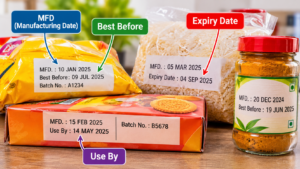
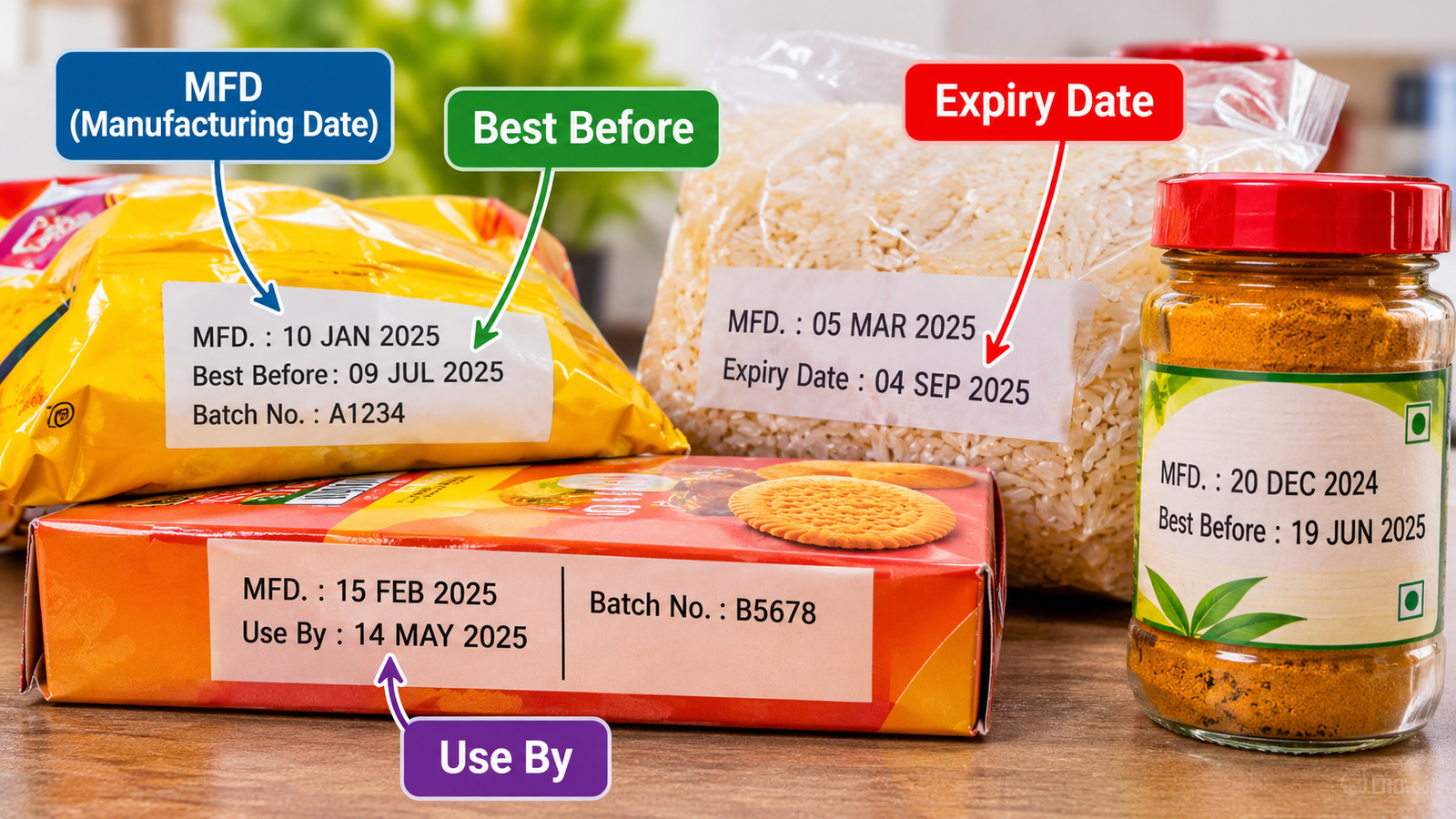
A best before date and an expiry date do not mean the same thing. In India, best before mainly indicates how long a correctly stored product is expected to retain its intended quality. Expiry or use by marks the end of the estimated period during which the product is expected to remain safe under the stated storage conditions.
No printed date can make mishandled, improperly refrigerated, opened, leaking, swollen or contaminated food safe.
Best before is mainly about quality; expiry or use by is about safety. Food past best before may sometimes remain safe if unopened, undamaged and stored exactly as instructed, but safety is not guaranteed. Do not consume food after expiry or use by. Discard food with damaged packaging or uncertain storage history.
Table of Contents
Best Before vs Expiry Date
| Label term | What it indicates | Consumer action |
|---|---|---|
| Best before | Expected quality under stated storage | Assess package and storage; safety afterward is not guaranteed |
| Expiry | End of the estimated safe period | Do not consume after the date |
| Use by | Safety-related end date | Do not consume even if it looks or smells normal |
| MFD | Date the food was manufactured | Read with expiry or shelf-life information |
| PKD | Date the food was packed | Do not treat it as the expiry date |
FSSAI defines best before as the end of the period during which food stored as directed remains fully marketable and retains its claimed qualities. It may still be safe afterward, but quality may have diminished. Expiry or use by is the end of the estimated period after which the product may not remain safe.
What Best Before Means
A best before date tells you how long the manufacturer expects unopened food to maintain its intended taste, aroma, texture, color or other quality when stored according to the label.
Biscuits may become stale, spices may lose aroma and cereal may lose crispness. These are quality changes, but they do not prove that food is dangerous. A date that has not passed does not prove safety. A torn pouch, broken seal, bulging can, insect contamination, moisture exposure or refrigeration failure can make food unsuitable earlier.
Also Read : Spices
Does best before guarantee safety afterward
No. FSSAI says the food may still be safe; it does not guarantee safety for every product or storage situation. Packaging, temperature, humidity, handling and whether the pack has been opened all matter.
Also Read : How to Balance Sodium Potassium
What Expiry and Use By Mean
Expiry and use by are safety related. Once the date has passed, the food should not be eaten, even if it looks and smells normal.
Food-poisoning microorganisms do not always cause a bad smell, unusual taste or visible change. A smell test cannot prove that food carrying a use by date is safe.
Source: UK Food Standards Agency Home Food Fact Checker
Past best before: quality may have declined; assess cautiously. Past expiry or use by: do not consume.
Also Read : Antioxidants
Also Read : Zinc
Common Date Abbreviations
| Abbreviation | Meaning | What it tells you |
|---|---|---|
| MFD / MFG | Date of manufacture | When the food was made |
| PKD / PKG | Date of packaging | When the food was packed |
| BBD / BB | Best before date | Expected quality period |
| EXP / EXD / ED | Expiry date | Safety-related end date |
| UB / UBD | Use by date | Safety-related end date |
| Batch / Lot No. | Production identifier | Helps trace a product or recall |
Source: FSSAI Labelling and Display FAQ
Read the wording around the date instead of relying on the number alone. A date such as 08/11/26 has little meaning unless you know whether it is manufacturing, packaging, best before or expiry.
Also Read : Fiber
How Indian Food Dates Are Displayed
| Shelf-life situation | Permitted display | Consumer note |
|---|---|---|
| Up to three months | Day month and year | Read the wording beside the date |
| More than three months | Month and year | A full day month and year may also be used |
| Storage-dependent shelf life | Special storage conditions declared | The date assumes these conditions were followed |
| After opening | Manufacturer may give an open-life instruction | Follow the shorter after-opening period |
Source: FSSAI date-marking provisions
Also Read : Magnesium
Storage Conditions Are Part of the Date
A printed date is valid only under the conditions used to establish it. Instructions such as store in a cool dry place or keep refrigerated at 2 to 8 C are not optional. If chilled food remained in a hot vehicle or outside refrigeration for an unknown period, the date alone cannot confirm safety.
Also Read : Iodine
Reject or discard the package if
- A can is swollen, bulging, deeply dented or badly rusted.
- A bottle, carton, pouch or jar is leaking.
- A vacuum seal is broken.
- There is visible mold, decay or insect infestation.
- The contents bubble or spurt unexpectedly.
- Frozen food appears to have thawed and refrozen.
- The date is unreadable or appears altered.
- The product is offered after expiry or use by.
Do not rely on the date alone: Discard food if the package is leaking, swollen, deeply dented, badly rusted, moldy, pest-damaged, unexpectedly spurting, thawed and refrozen, or has an unreadable or altered date. A valid printed date cannot make mishandled food safe.
Also Read : Minerals
Does Opening Change the Date
Yes. The printed date usually applies to an unopened package stored as directed. After opening, instructions such as refrigerate after opening, consume within three days or use within four weeks become more important.
Example: A jar says EXP December 2026 and after opening refrigerate and consume within 15 days. If opened on August 1, follow the 15-day instruction rather than waiting until December.
After-opening instruction example
The printed expiry usually applies to an unopened package stored as directed.
Printed expiry: December 2026
Opened: August 1, 2026
Label says consume within 15 days after opening
Practical limit: follow the 15-day instruction, not December 2026
Also Read : Carbohydrates
Can You Eat Food After Best Before
There is no universal answer such as seven days or three months. Use this conservative framework.
Also Read : Bones
Use verify or discard
This framework reduces uncertainty but does not certify microbiological safety.
| Question | If yes | If no or uncertain |
|---|---|---|
| Does the label say best before rather than expiry or use by? | Continue checking | Do not consume after expiry or use by |
| Is the package unopened and the seal intact? | Continue | Follow open-life instructions or discard |
| Was it stored exactly as directed? | Continue | Discard |
| Is it free from leaks swelling pests and moisture? | Continue | Discard |
| Is there no mold decay rancid odor or major change? | May be usable depending on the product | Discard |
| Is manufacturer guidance available? | Follow it | Choose the safer option |
This framework reduces uncertainty; it does not certify microbiological safety. Pregnant, older or immunocompromised people should be particularly cautious with food of uncertain storage history.
Also Read : Immunity
Product examples and important limits
These are decision aids, not extensions of a manufacturer's declared shelf life.
| Food example | Possible change after best before | Important limitation |
|---|---|---|
| Sealed biscuits or namkeen | Staleness or loss of crispness | Humidity damaged packaging or rancid oil can make it unsuitable |
| Dry rice or dal | Reduced quality or insects | Moisture exposure can cause mold even before the date |
| Ground spices | Loss of aroma or flavor | Moisture mold or insects require disposal |
| UHT milk | Quality deterioration | After opening refrigeration and shorter open life apply |
| Refrigerated dairy | Spoilage and microbial risk | Follow the exact label; products differ |
| Frozen food | Freezer burn or texture change | Thawing and refreezing can undermine safety |
| Canned food | Gradual quality change | Bulging leakage deep dents rust or spurting require disposal |
| Infant or medical nutrition | Nutrient and safety concerns | Do not improvise beyond the labeled date |
Also Read : Which is The Best Diet Plan
Online Grocery Checks
Online dates may not match the exact package delivered. Check the physical package. FSSAI states that food delivered by an e-commerce food business should have 30 percent or 45 days of shelf life remaining before expiry at delivery.
Source: FSSAI e-commerce direction
Remaining shelf-life calculation
Example dates: manufactured January 1, expires May 1 and delivered March 15. This is a consumer estimate, not a legal compliance determination.
Remaining shelf life (%) = Days from delivery to expiry / Total labeled shelf-life days x 100
Example: 47 / 120 x 100 = 39.2% remaining shelf life
Source: FSSAI e-commerce direction
Also Read : How to Calculate Macros in Indian Food at Home
Delivery Checklist
| Check | What to verify | Action if unsatisfactory |
|---|---|---|
| Expiry or use by | Readable date and enough time for intended use | Reject or request replacement |
| Seal and package | No leaks swelling deep dents or broken seals | Reject |
| Temperature | Chilled or frozen food arrived appropriately cold | Reject if temperature history is doubtful |
| Label details | Batch number and FSSAI license are present | Photograph and report if missing |
| Date integrity | Not smudged overwritten or altered | Do not guess; return the product |
| Evidence | Photograph package and keep invoice | Use for replacement or complaint |
Source: FSSAI Food Safety Connect
Also Read : How to Complete a 30gm Protein gap
Ten Common Date-Label Mistakes
| Mistake | Why it is risky or incorrect |
|---|---|
| Treating best before and expiry as identical | Best before concerns quality; expiry or use by is safety-related |
| Assuming every product is safe after best before | May remain safe is not a guarantee |
| Using smell for use-by food | Food-poisoning organisms may not produce a detectable smell |
| Ignoring storage instructions | The date assumes stated storage was followed |
| Using the unopened date after opening | The shorter after-opening instruction applies |
| Confusing MFD or PKD with expiry | Manufacture and packaging dates are not safety end dates |
| Applying one rule to every food | Processing packaging and storage vary by product |
| Trusting a valid date on a damaged pack | Package damage can matter more than the date |
| Trusting the online image | The delivered batch and date can differ |
| Guessing an unclear date | Return the product or contact the manufacturer |
Also Read : Raw vs Cooked Weight for Nutrition Tracking
Also Read : How to Count Cooking Oil in Indian Recipes
Frequently Asked Questions
Is best before the same as expiry in India?
No. Best before primarily indicates expected quality under stated storage conditions. Expiry or use by marks the end of the estimated safe period.
Can shops sell food after expiry?
FSSAI states that after expiry or use by, the product may not remain safe and must not be sold or distributed for human consumption.
Can shops sell food after best before?
The position can depend on safety, representation and other compliance requirements. A discount is not proof of safety. Choose an in-date package when uncertain.
Can I eat biscuits one month after best before?
There is no reliable one-month rule. Package condition, storage, moisture, insects, mold and rancidity matter.
Does cooking make expired food safe?
What if the expiry date is overwritten?
Do not buy or consume it. Photograph the label and bill, contact the retailer or manufacturer and file a complaint if needed.
Source: FSSAI Food Safety Connect
The Bottom Line
Best before is primarily a quality date, not a promise of safety afterward. Expiry or use by is a safety-related limit; do not consume after it. After opening, follow the shorter open-life instruction. Do not rely on the date when packaging or storage is doubtful.
A food label works only when its wording, storage conditions, package condition and handling history are considered together.
Disclaimer: This article provides general food-label and food-safety education. It is not legal, medical or product-specific advice. Storage requirements and shelf life vary by product and manufacturer. When a package is damaged, storage history is uncertain or the label is unclear, contact the manufacturer or choose the safer option and discard the food.
Also Read : How to Calculate Daily Calories
Sources and Further Reading
- Labelling and Display Regulations, Compendium Version VIII. September 9, 2025. Official source
- Labelling and Display Regulations, Compendium Version VII. April 3, 2025. Official source
- Frequently Asked Questions on Labelling and Display. November 1, 2023. Official source
- Eat Right India and FSSAI. How to Read Labels. Official source
- E-commerce Food Business Operator Direction. Official source
- Food Safety Connect Consumer Grievance FAQs. Official source
- UK Food Standards Agency. Best Before and Use By Dates. Official source
- UK Food Standards Agency. Home Food Fact Checker. Official source