Checking blood pressure at home involves more than putting on a cuff and pressing a button. The machine, cuff size, sitting position, recent activity and even a full bladder can influence the result.
For most adults, the most useful home BP number is not a single reading but an average collected under consistent conditions. The 2025-2026 Indian Guidelines on Hypertension classify a mean home blood pressure of 135/85 mmHg or higher as elevated. This home threshold differs from the clinic threshold and should not be used to diagnose yourself from one measurement.
This guide explains how to select a monitor, measure BP correctly, complete a seven-day record and recognize readings that need medical attention.
Table of Contents
Use a validated automatic upper-arm BP monitor with a cuff that fits your arm. Avoid tea, coffee, tobacco and exercise for at least 30 minutes, empty your bladder and sit quietly for five minutes. Keep your back supported, feet flat and uncrossed, and your bare arm supported at heart level. Take readings in the morning and evening for seven days. A mean home BP of 135/85 mmHg or above requires clinical assessment; one high reading alone does not confirm hypertension.
Source: Indian Guidelines on Hypertension 2025-2026 – https://www.japi.org/article/japi-74-5-s1-8
What the Two Blood Pressure Numbers Mean
Blood pressure is written as two numbers, such as 128/82 mmHg.
- Systolic blood pressure, the first number, is the pressure in the arteries when the heart contracts.
- Diastolic blood pressure, the second number, is the pressure when the heart relaxes between beats.
- mmHg means millimetres of mercury, the standard unit used for blood pressure.
Both numbers matter. A person may have an elevated systolic value, an elevated diastolic value or both.
Source: WHO India Hypertension – https://www.who.int/india/health-topics/hypertension
Also Read : Gut Bacteria
Also Read : Organic Food
Why Measure Blood Pressure at Home
Home readings show what happens outside a clinic and provide multiple measurements across several days. The record may help a clinician identify consistently elevated blood pressure, response to prescribed treatment, white-coat hypertension or masked hypertension.
- White-coat hypertension means BP is high in a clinic but lower at home.
- Masked hypertension means clinic BP appears below the diagnostic threshold but home BP is elevated.
The Indian guideline defines white-coat hypertension using clinic BP of at least 140/90 mmHg with home BP below 135/85 mmHg. Masked hypertension is the reverse pattern: clinic BP below 140/90 mmHg but mean home BP at least 135/85 mmHg. These patterns require professional assessment rather than self-diagnosis.
Home monitoring does not replace medical appointments, examination, blood tests or 24-hour ambulatory monitoring when these are clinically necessary.
Average home blood pressure formulas
Average systolic BP = Sum of included systolic readings ÷ Number of included readings
Average diastolic BP = Sum of included diastolic readings ÷ Number of included readings
Calculate systolic and diastolic averages separately. For the seven-day protocol described in the article, exclude day 1 and average the accepted readings from days 2 to 7.
Also Read : How to Strengthen Your Nerves
Normal Home Blood Pressure Readings in India
For general interpretation, the average rather than the highest individual reading is the important number.
| Average or reading | General interpretation |
|---|---|
| Mean home BP below 135/85 mmHg | Below the Indian home-hypertension threshold, but not automatically the ideal treatment target for every person |
| Mean home BP at least 135 systolic or at least 85 diastolic | Meets the Indian home-BP threshold for elevated BP and should be discussed with a healthcare professional |
| Office BP at least 140 systolic or at least 90 diastolic | Indian office threshold used in clinical assessment |
| Reading above 180 systolic or above 120 diastolic | Repeat after at least one minute and follow the urgent-action guidance in the article |
Note: A single reading does not diagnose hypertension. Individual treatment targets may differ.
Also Read : 23 Superfoods
Does BP Have a Different Normal Range for Every Age
Age affects cardiovascular risk and treatment decisions, but an age-wise internet chart should not be used to decide that a high reading is harmless. Indian treatment targets are individualized for age, frailty, postural symptoms and existing disease. A person taking BP medicine may have a clinician-set target below the general home diagnostic threshold.
Also Read : Biohacking
How to Choose a Home Blood Pressure Monitor
Choose an automatic upper-arm monitor that has been independently validated. STRIDE BP maintains lists of validated monitors. Its preferred home devices are upper-arm models supported by an approved validation study and useful storage or data-transfer features.
Source: STRIDE BP validated monitors – https://www.stridebp.org/BP-monitors/
Do not assume that every popular or expensive machine has been clinically validated. WHO India training material notes that many digital devices available in the market have not undergone independent validation.
Source: India Hypertension Control Initiative training manual – https://cdn.who.int/media/docs/default-source/india-news/india-hypertension-control-initiative/medical-officer-training-manual-using-paper-based-system.pdf
Also Read : Natural Remedies Backed by Science
Upper Arm Wrist or Finger Monitor
A validated upper-arm monitor is generally preferred. The Indian guideline does not recommend finger and wrist monitors for routine home measurement because their readings can be less reliable. If a wrist monitor is medically necessary, ask a healthcare professional to check your technique and compare it with a clinical measurement.
Source: Indian Guidelines on Hypertension 2025-2026 – https://www.japi.org/article/japi-74-5-s1-8
Also Read : Fox Nuts
How to Choose the Correct BP Cuff Size
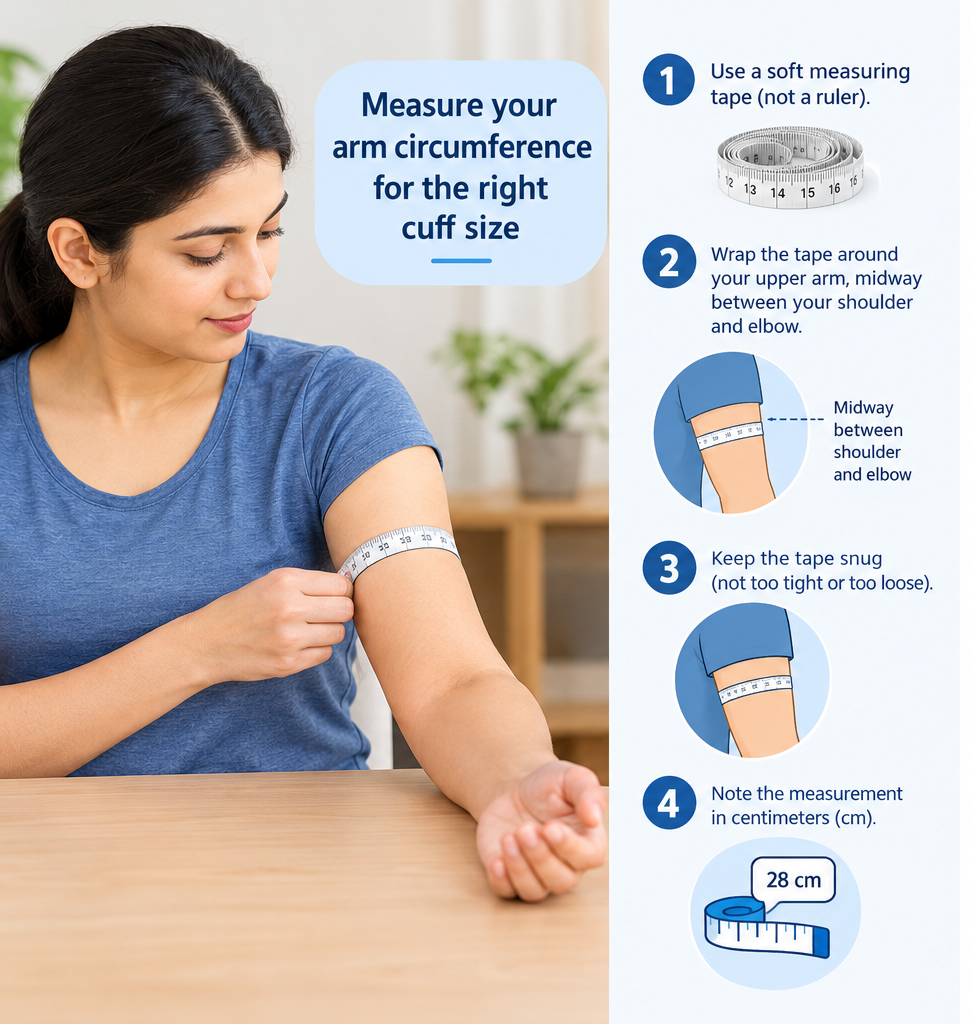
Measure the circumference of your bare upper arm at its midpoint. Compare that number with the arm range printed on the cuff or in the monitor instructions.
Blood pressure cuff size guide
| Upper-arm circumference | Cuff category | Approximate bladder dimensions |
|---|---|---|
| 22-26 cm | Small | 12 x 22 cm |
| 27-34 cm | Medium | 16 x 30 cm |
| 35-44 cm | Large | 16 x 36 cm |
| 45-52 cm | Extra-large | 16 x 42 cm |
Note: The dimensions describe the inflatable bladder. Match a consumer cuff to the manufacturer's validated arm-circumference range.
These dimensions refer to the inflatable bladder, not necessarily the complete fabric cuff. Consumer devices may use different cuff designs, so the manufacturer’s validated arm-circumference range should determine compatibility. A cuff that is too small can produce a falsely high result. An oversized cuff may also produce an inaccurate result.
Source: Indian Guidelines on Hypertension 2025-2026 – https://www.japi.org/article/japi-74-5-s1-8
Also Read : Almonds vs Pistachios
Also Read : Zinc
How to Measure Blood Pressure at Home Correctly
Prepare for the Reading
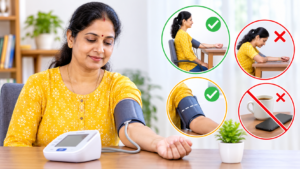
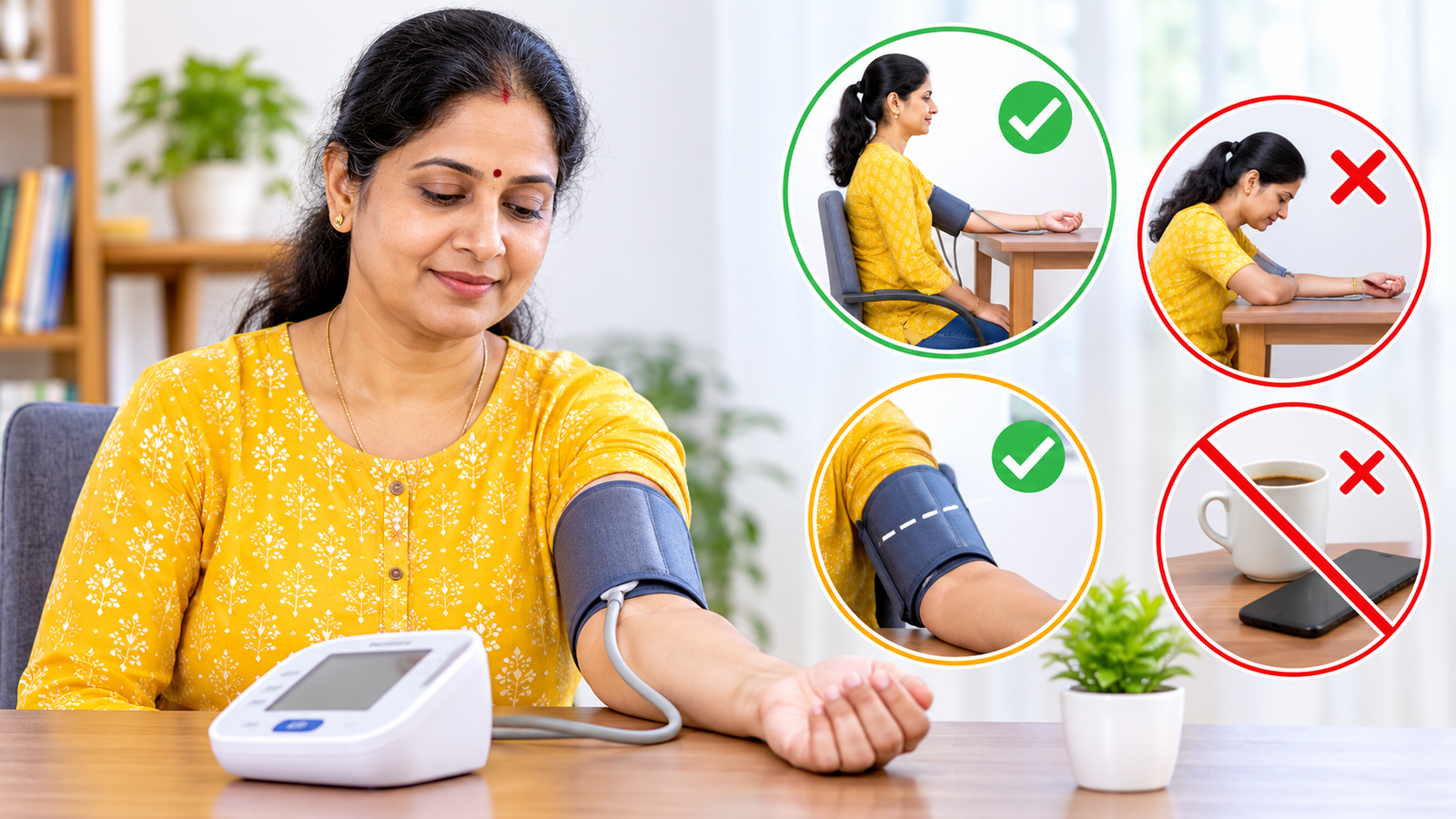
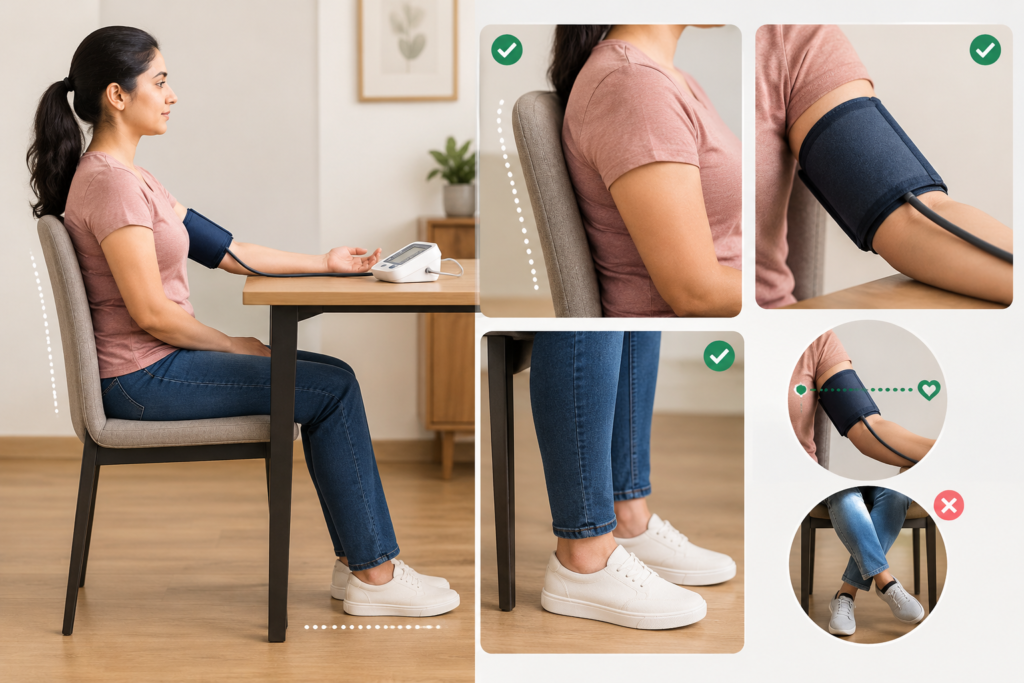
For at least 30 minutes before measurement, do not exercise, smoke or use tobacco, and avoid tea, coffee and other caffeinated products. Empty your bladder and sit quietly for at least five minutes before starting.
Source: Indian Guidelines on Hypertension 2025-2026 – https://www.japi.org/article/japi-74-5-s1-8
Source: India Hypertension Control Initiative – https://cdn.who.int/media/docs/default-source/india-news/india-hypertension-control-initiative/medical-officer-training-manual-using-paper-based-system.pdf
Sit in the Correct Position
Position the Cuff and Arm
- Put the cuff on a bare upper arm.
- Place its lower edge approximately 2-3 cm above the elbow crease.
- Make the cuff snug, but not painfully tight.
- Rest the arm on a table or firm support.
- Position the middle of the cuff approximately at heart level.
Source: Indian Guidelines on Hypertension 2025-2026 – https://www.japi.org/article/japi-74-5-s1-8
Take Two Readings
Start the machine and remain still. After the first measurement, wait one to two minutes and take another reading. Record the numbers exactly as displayed. Do not round 137/86 to 140/90, and do not delete a result simply because it is higher than expected. If two readings are very different, remain seated, check your position and take an additional reading. Repeated large differences should be discussed with a healthcare professional.
Also Read : Immunity
Also Read : Fiber
The Seven Day Home BP Monitoring Method
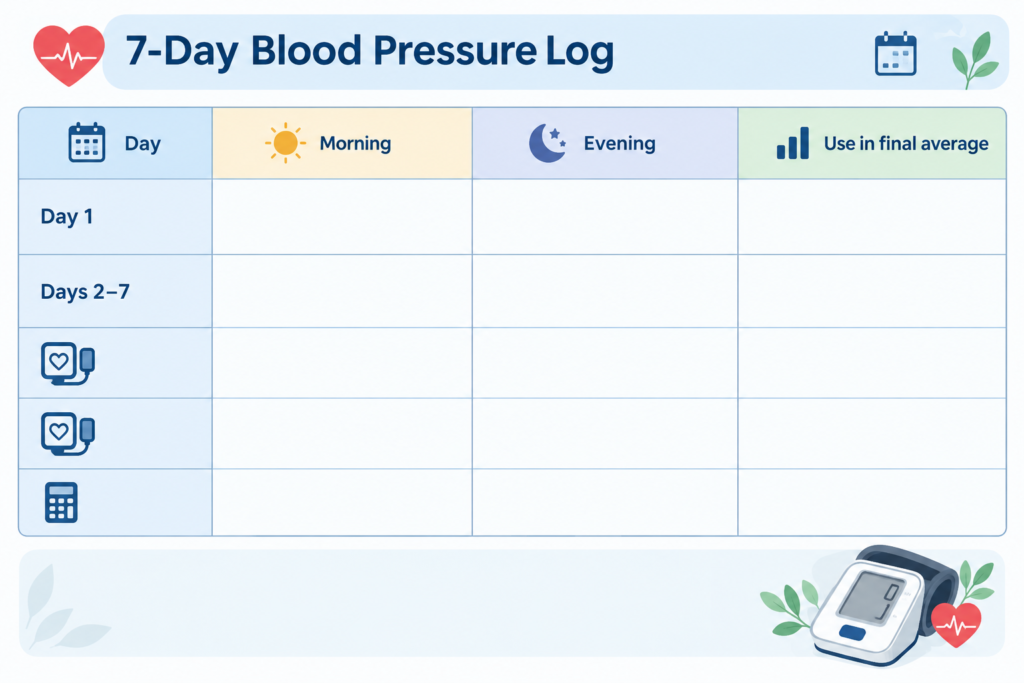
The latest Indian guideline recommends readings in the morning before BP medication and again at night. At each session, it advises taking two measurements one to two minutes apart for seven consecutive days. Readings from the first day are excluded from the final home average.
Also Read : Antioxidants
Seven-day home BP monitoring schedule
| Day | Morning | Evening | Use in final average |
|---|---|---|---|
| Day 1 | Two readings | Two readings | No - adaptation day |
| Days 2-7 | Two readings | Two readings | Yes |
| Final step | Calculate session means | Calculate session means | Average the 12 session means |
Note: Follow a different schedule if your clinician has given you individual instructions.
If your clinician gives you a different schedule, follow that instruction. Do not delay prescribed medicine or change its timing merely to complete a measurement protocol.
Also Read : How to Balance Sodium Potassium Levels
Also Read : Trans Fat Myths
Which Arm Should You Use
At an initial clinical assessment, BP should be checked in both arms. Subsequent readings are generally taken from the arm with the higher value, unless a healthcare professional advises otherwise. Use the same arm, chair, monitor, cuff and approximate times each day.
Source: Indian Guidelines on Hypertension 2025-2026 – https://www.japi.org/article/japi-74-5-s1-8
Also Read : Magnesium
How to Calculate Your Average Home BP
Calculate systolic and diastolic averages separately.
Average systolic BP = total of included systolic readings / number of included readings
Average diastolic BP = total of included diastolic readings / number of included readings
Suppose the 12 morning and evening session averages from days 2-7 are 132/82, 128/80, 134/84, 130/81, 136/86, 131/83, 129/80, 133/82, 135/85, 130/79, 132/81 and 128/80.
Worked home BP average calculation
| Calculation | Result |
|---|---|
| Systolic total | 1,578 |
| 1,578 ÷ 12 | 131.5 |
| Diastolic total | 983 |
| 983 ÷ 12 | 81.9 |
| Rounded home average | 132/82 mmHg |
Note: This is a hypothetical calculation example, not a real patient record or diagnosis.
Also Read : Minerals
Ten Common Home BP Monitoring Mistakes
Ten common home BP monitoring mistakes
| Mistake | Why it matters | Better method |
|---|---|---|
| 1. Wrong cuff size | A small cuff can read falsely high | Measure your arm and check the cuff's stated range |
| 2. Unvalidated or finger device | Device accuracy may be uncertain | Choose a validated automatic upper-arm monitor |
| 3. Cuff over clothing | Fabric can affect placement and compression | Apply it to a bare upper arm |
| 4. Immediately after activity | Exercise and hurried movement can affect BP | Avoid exercise for 30 minutes and rest for five minutes |
| 5. Tea or coffee immediately before | Caffeine may temporarily affect the result | Avoid caffeinated drinks for at least 30 minutes |
| 6. Full bladder | Bladder discomfort can raise the result | Use the toilet before sitting down |
| 7. Crossed legs or unsupported feet | Poor positioning may alter the reading | Keep feet flat and legs uncrossed |
| 8. Unsupported arm or wrong height | Arm position can distort the result | Rest the arm on a table at heart level |
| 9. Talking laughing or using the phone | Movement can raise or destabilise the result | Stay quiet and still |
| 10. Reacting to one reading | BP naturally varies | Repeat correctly and use a multi-day average |
Note: The size and direction of measurement error vary between people and situations.
In the India Hypertension Control Initiative manual, common errors were associated with approximate increases or variations ranging from 2-8 mmHg for crossed legs, about 10 mmHg for talking or an unsupported arm, and 10-15 mmHg for a full bladder. These figures illustrate possible measurement error; they do not predict the exact change in every person.
Source: India Hypertension Control Initiative training manual – https://cdn.who.int/media/docs/default-source/india-news/india-hypertension-control-initiative/medical-officer-training-manual-using-paper-based-system.pdf
Also Read : Carbohydrates
Also Read : Bones
When to Contact a Doctor
Arrange medical assessment if any of the following applies.
- Your home average is at least 135/85 mmHg.
- Your readings are repeatedly higher than the target set by your clinician.
- Home readings remain high even though you take prescribed medicine.
- Readings are repeatedly much lower than usual, particularly with faintness, weakness or dizziness.
- Your pulse is repeatedly irregular or the monitor frequently shows an irregular-heartbeat warning.
- Home and clinic readings differ substantially.
- You are unsure whether the cuff or device is suitable.
Do not stop, start, double or reduce prescribed BP medicine based only on home readings. The Indian guideline advises patients not to change medication without consulting their physician.
Source: Indian Guidelines on Hypertension 2025-2026 – https://www.japi.org/article/japi-74-5-s1-8
Also Read : Iodine
When a High BP Reading Is an Emergency
If the monitor shows more than 180 systolic and/or more than 120 diastolic, stay seated, wait at least one minute, repeat the measurement with correct positioning and check for new concerning symptoms.
Seek emergency medical assistance immediately if the repeated reading remains in this range and you have chest pain, shortness of breath, new weakness or numbness, difficulty speaking, a sudden change in vision, severe back pain, confusion, collapse or another severe new symptom. A reading above 180/120 mmHg with these symptoms can represent a hypertensive emergency. Do not wait for it to settle on its own.
Important: If a reading is above 180/120 mmHg, wait at least one minute and repeat it correctly.
Seek emergency medical help immediately if the repeated reading remains in this range and there is chest pain, shortness of breath, new weakness or numbness, difficulty speaking, a sudden vision change, severe back pain, confusion, collapse, or another severe new symptom.
Also Read : Which is The Best Diet Plan
Who Needs Extra Guidance
Pregnancy
Pregnancy has separate BP thresholds, risks and management pathways. Use a device validated for pregnancy and follow the monitoring plan provided by the obstetric team. Do not rely only on the general adult table in this article.
Source: STRIDE BP pregnancy device validation – https://www.stridebp.org/pregnancy-pdf/
Irregular Heart Rhythm
Automatic oscillometric machines may be less reliable in people with atrial fibrillation or certain other rhythm abnormalities. Additional readings or professional measurement may be necessary.
Source: Indian Guidelines on Hypertension 2025-2026 – https://www.japi.org/article/japi-74-5-s1-8
Older Adults or People with Dizziness on Standing
A clinician may compare sitting and standing BP to check for postural hypotension. Individual targets may also differ for frail older adults.
Children and Teenagers
Children require age-, sex- and height-specific interpretation. The adult thresholds in this article should not be applied to them.
Also Read : How to Calculate Macros in Indian Food at Home
Also Read : How to Complete a 30 gram Protein Gap
Frequently Asked Questions
Is the First or Second BP Reading More Accurate?
The first reading is often higher because the person is still settling down. Take two readings one to two minutes apart and record both instead of choosing whichever looks better. A multi-day average is more useful.
Should I Check BP Before or After Taking Medicine?
Can I Check My BP While Sitting on a Bed?
A firm chair is preferable because it allows the back to be supported and both feet to remain flat. If a chair is unavailable, reproduce the position as closely as possible and tell your clinician how the measurements were taken.
Is the Left Arm Always Used for BP?
No. BP should initially be compared in both arms, ideally by a healthcare professional. The arm producing the higher reading is generally used for subsequent monitoring unless advised otherwise.
How Often Should I Check BP After the Seven Day Record?
Frequency depends on whether you are being screened, have diagnosed hypertension, recently changed treatment or have another condition. Ask your clinician for a schedule.
Can a Home BP Machine Diagnose Hypertension?
No single home reading confirms hypertension. A structured series can provide useful evidence, but diagnosis and treatment decisions require clinical interpretation.
Source: Indian Guidelines on Hypertension 2025-2026 – https://www.japi.org/article/japi-74-5-s1-8
Also Read : Raw vs Cooked Weight for Nutrition Tracking
Key Takeaways
- Use a validated automatic upper-arm monitor.
- Select the cuff according to arm circumference.
- Avoid tea, coffee, tobacco and exercise for at least 30 minutes.
- Empty your bladder and rest for five minutes.
- Keep your back supported, feet flat and arm at heart level.
- Take two readings one to two minutes apart.
- Record morning and evening readings for seven days and exclude day one from the final average.
- A mean home BP of at least 135/85 mmHg requires clinical assessment.
- Never change prescribed medicine on your own.
- A repeated reading above 180/120 mmHg with serious new symptoms requires emergency help.
Medical disclaimer: This content is for general educational purposes only and is not a substitute for professional medical advice, diagnosis, or treatment. Consult a qualified healthcare professional for guidance appropriate to your medical situation. Never stop or change prescribed blood-pressure medication without speaking to the prescribing clinician.
Also Read : How to Count Cooking Oil in Indian Recipes
Sources and Further Reading
- Mehta N, Mathur G, Pal J, et al. Indian Guidelines on Hypertension 2025-2026. Journal of the Association of Physicians of India. May 2026.
https://www.japi.org/article/japi-74-5-s1-8 - World Health Organization India. Hypertension.
https://www.who.int/india/health-topics/hypertension - WHO India and Ministry of Health and Family Welfare. India Hypertension Control Initiative Medical Officer Training Manual.
https://cdn.who.int/media/docs/default-source/india-news/india-hypertension-control-initiative/medical-officer-training-manual-using-paper-based-system.pdf - STRIDE BP. Validated Blood Pressure Monitors.
https://www.stridebp.org/BP-monitors/ - American Heart Association. When to Call for Help for a Blood Pressure Reading Above 180/120 mmHg. Reviewed August 2025.
https://www.heart.org/en/health-topics/high-blood-pressure/understanding-blood-pressure-readings/when-to-call-911-for-high-blood-pressure
Also Read : Indian Portion Size