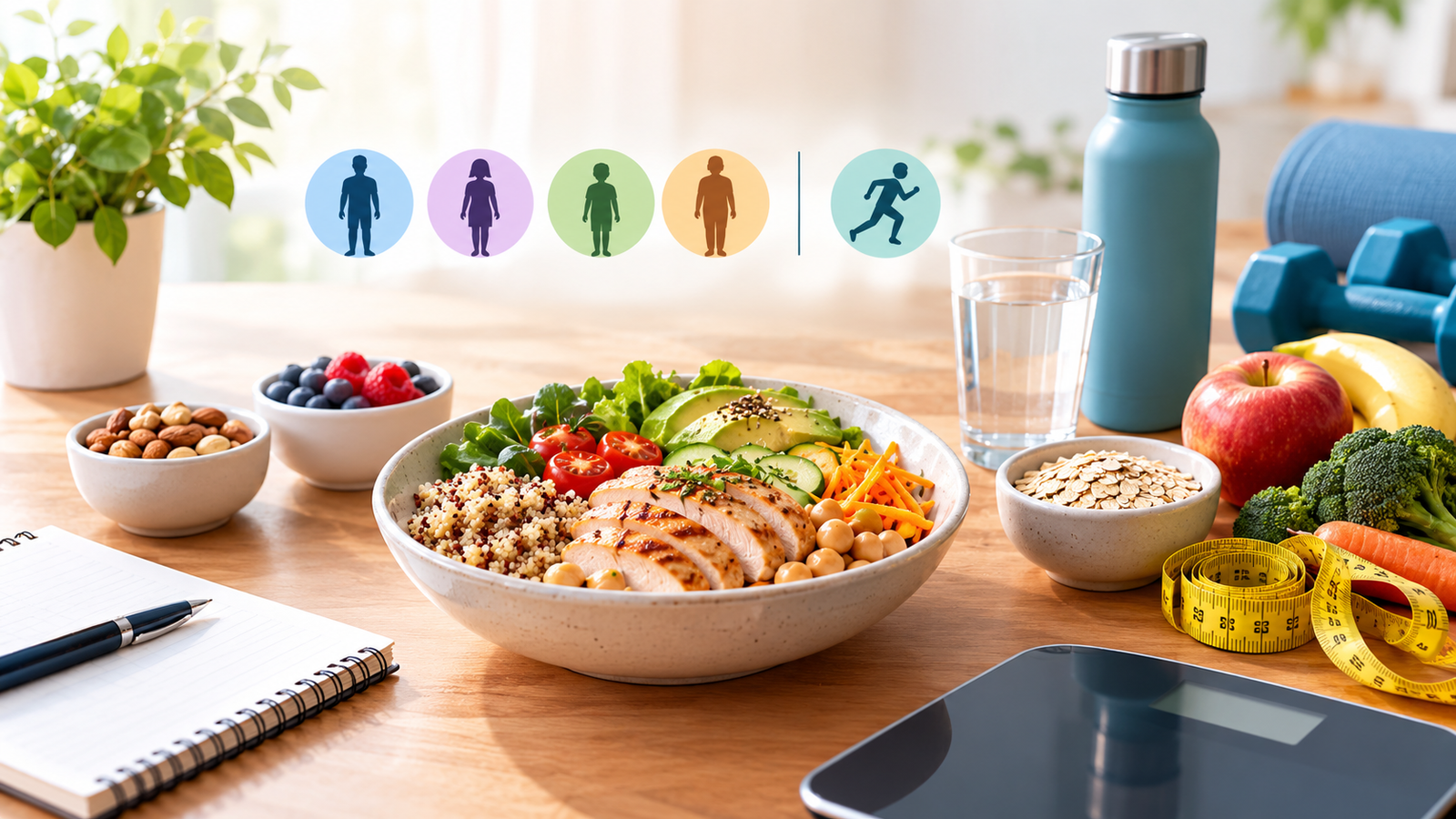
Your calorie needs are not the same as someone else’s. Age, sex, height, weight, activity level, and your goal all affect how much energy you need each day.
The good news is that you do not need to guess. You can estimate your daily calorie requirements with a simple BMR and TDEE calculation. Then, you can set protein, fat, carbohydrates, and fiber around that calorie target.
Quick answer: How do you calculate daily calories and macros?
Start by estimating your BMR, which is the energy your body needs at rest. Multiply your BMR by an activity factor to estimate your TDEE, or total daily energy expenditure. Use your TDEE as a starting point for weight maintenance. Then adjust calories for weight loss or gain and calculate protein, fat, carbohydrates, and fiber based on your needs.
These are estimates, not exact measurements. Your real needs can change with activity, body composition, health status, and other factors.
Table of Contents
What determines your daily calorie requirements?
Your calorie needs depend on several factors rather than one fixed number.
The main factors are:
- Age: Energy needs often change as you get older.
- Sex: Average energy needs differ between males and females.
- Height: Taller bodies generally require more energy.
- Weight: Body size affects energy expenditure.
- Activity level: Exercise and everyday movement can substantially change calorie needs.
- Goal: Weight loss, maintenance, and weight gain require different calorie targets.
- Life stage and health: Pregnancy, breastfeeding, some medical conditions, and certain medications can change nutritional needs.
WHO also states that a healthy diet varies according to individual characteristics such as age, gender, lifestyle, physical activity, culture, and locally available foods.
[WHO — Healthy diet]
This is why a calorie number copied from a generic chart may not fit you perfectly.
Also Read : Biohacking
Calorie requirement by age and gender
General calorie tables can provide broad estimates, but they should not replace an individualized calculation.
For example, two adults of the same age can need very different amounts of food if one works at a desk and the other has a physically demanding job.
The same applies to two people with the same weight. Height, body composition, activity, and sex can change their estimated energy needs.
For a more individualized estimate, use your age, sex, height, weight, and activity level together.
Also Read : How to Improve Your Eyesight
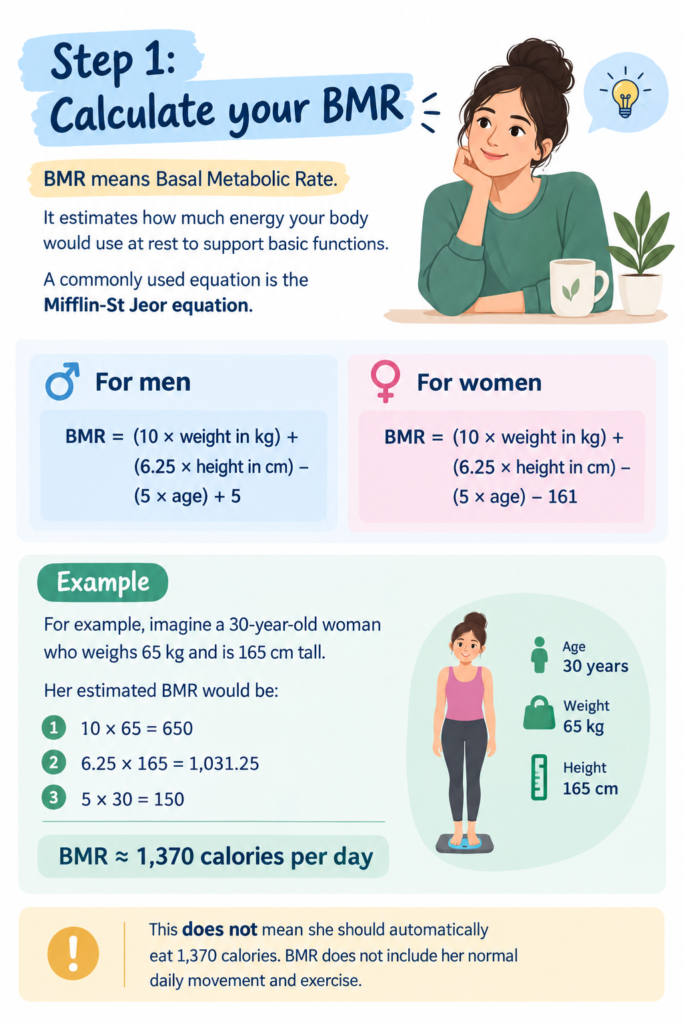
Step 1: Calculate your BMR
BMR = (10 × weight in kg) + (6.25 × height in cm) − (5 × age) + 5
BMR = (10 × weight in kg) + (6.25 × height in cm) − (5 × age) − 161
For example, imagine a 30-year-old woman who weighs 65 kg and is 165 cm tall.
Her estimated BMR would be:
10 × 65 = 650
6.25 × 165 = 1,031.25
5 × 30 = 150
BMR ≈ 1,370 calories per day
This does not mean she should automatically eat 1,370 calories. BMR does not include her normal daily movement and exercise.
Also Read : Hormonal Imbalance
Also Read : Ayurvedic Herbs
Step 2: Calculate your TDEE
TDEE means Total Daily Energy Expenditure.
It is an estimate of the calories you burn in a typical day after accounting for activity.
A simple method is:
TDEE = BMR × Activity Factor
A commonly used activity framework is:
Activity level | Example | Activity factor |
Sedentary | Little exercise, mostly sitting | 1.20 |
Lightly active | Light exercise or sports 1–3 days/week | 1.375 |
Moderately active | Moderate exercise around 3–5 days/week | 1.55 |
Very active | Hard exercise most days | 1.725 |
Extremely active | Very demanding training or physical work | 1.90 |
These factors are estimates. Your actual energy expenditure can differ.
The NIH Body Weight Planner also uses information such as age, sex, body weight, and physical activity to create individualized calorie and activity targets. It is intended for adults and is not designed for children or pregnant or breastfeeding women.
[NIDDK — About the Body Weight Planner]
Example TDEE calculation
Using the example above:
BMR ≈ 1,370 calories
If she is moderately active:
TDEE = 1,370 × 1.55
TDEE ≈ 2,124 calories per day
That gives her a starting estimate for calories for weight maintenance.
TDEE = BMR × Activity Factor
Also Read : Spice Secrets
Step 3: Choose your calorie target
Once you have your TDEE, your goal determines what comes next.
Calories for weight maintenance
For maintenance, start around your estimated TDEE.
Maintenance Calories ≈ TDEE
In the example:
Estimated maintenance = about 2,124 calories/day
This is a starting point, not a guarantee.
Your actual maintenance intake may be somewhat higher or lower. Track your body-weight trend and adjust gradually rather than reacting to one day’s reading.
Calories for weight loss
For weight loss, you generally need to consume fewer calories than your body uses.
A moderate calorie reduction is often more practical than making a very large cut. NIH notes that combining calorie reduction with physical activity can be effective for weight loss, while also emphasizing gradual, sustainable approaches.
[NIH — Healthy Weight Control]
Weight-Loss Calories = TDEE − Chosen Calorie Deficit
For the example:
TDEE ≈ 2,124 calories
A starting target might be around:
1,700–1,900 calories/day
The appropriate deficit depends on the individual. A healthcare professional or registered dietitian can help determine a suitable target, particularly if you have a medical condition or a history of disordered eating.
Calories for weight gain
For weight gain, you generally need to consume more energy than you use.
Weight-Gain Calories = TDEE + Chosen Calorie Surplus
Instead of dramatically increasing food overnight, a gradual increase can be easier to manage.
Choose nutritious calorie sources such as:
- Milk or fortified soy beverages
- Yogurt
- Nuts and seeds
- Peanut or other nut butters
- Whole grains
- Rice and potatoes
- Pulses and beans
- Eggs, fish, chicken, tofu, or other protein foods
The goal is not simply to increase calories. Food quality still matters.
For the example:
TDEE ≈ 2,124 calories
A starting target might be around:
2,300–2,500 calories/day
The appropriate surplus depends on the individual. A healthcare professional or registered dietitian can help determine a suitable target, particularly if you have a medical condition or a history of disordered eating.
Also Read : Migraine
Step 4: Calculate your daily protein requirement
Protein needs depend on body weight, age, health, activity, and life stage.
For healthy adults, an established reference value is approximately 0.83 g of protein per kg of body weight per day. India’s National Institute of Nutrition also lists 0.83 g/kg/day as the RDA for adult men and women in its 2020 recommendations.
[ICMR-NIN — Summary of recommended protein requirements for Indians 2020]
Protein Target = Body Weight (kg) × 0.83 g/kg
For a 65 kg adult:
65 × 0.83 = 54 g protein/day
That is a general reference value for healthy adults, not necessarily the ideal target for every person.
People who train regularly, older adults, people recovering from illness, and those pursuing specific body-composition goals may have different requirements. Evidence and recommendations vary by population and goal.
Protein example
A day could include protein from:
For vegetarian diets, combining varied plant protein sources across the diet can help provide essential amino acids. India’s NIN dietary guidance emphasizes good-quality protein and appropriate combinations of foods.
[ICMR-NIN — Dietary Guidelines for Indians]
Also Read : Mental Health
Step 5: Calculate your daily fat requirement
Fat provides 9 calories per gram.
Instead of choosing an arbitrary number of grams, you can first choose a percentage of your calorie target.
Fat Calories = Daily Calories × Fat Percentage
Fat Grams = Fat Calories ÷ 9
For example, with 1,800 calories and 30% from fat:
1,800 × 0.30 = 540 calories from fat
540 ÷ 9 = 60 g fat
WHO recommends limiting total fat to around 30% or less of total energy intake for adults in its guidance aimed at preventing unhealthy weight gain, while emphasizing that fat quality matters too. Unsaturated fats are preferred over saturated and trans fats.
[WHO — Healthy diet]
Good sources can include nuts, seeds, fish, avocado, and plant oils.
Also Read : Gut Bacteria
Step 6: Calculate your daily carbohydrate requirement
Carbohydrates provide 4 calories per gram.
You do not necessarily need to force a fixed carbohydrate percentage onto every diet. A useful approach is to set protein and fat first, then use the remaining calories for carbohydrates.
Carb Calories = Total Calories − Protein Calories − Fat Calories
Carbohydrate Grams = Carb Calories ÷ 4
Example
Suppose your daily target is:
1,800 calories
Protein:
90 g × 4 = 360 calories
Fat:
60 g × 9 = 540 calories
Remaining calories:
1,800 − 360 − 540 = 900 calories
Carbohydrates:
900 ÷ 4 = 225 g
So the example target becomes:
- Calories: 1,800 kcal
- Protein: 90 g
- Fat: 60 g
- Carbohydrates: 225 g
This is an example calculation, not a universal protein carbs fat ratio per day.
WHO recommends that carbohydrate intake primarily come from foods such as whole grains, vegetables, fruits, and pulses, emphasizing carbohydrate quality rather than simply focusing on the gram total.
[WHO — Carbohydrate intake for adults and children]
Also Read : Calcium Deficiency
Step 7: Calculate your daily fiber requirement
Fiber is different from protein, carbohydrates, and fat because it is not simply another macro to balance by percentage.
For adults, a useful general target is at least 25 g of naturally occurring dietary fiber per day, according to current WHO guidance.
[WHO — Healthy diet]
The U.S. National Academies’ reference values are higher for many adult groups, such as 38 g/day for men aged 19–50 and 25 g/day for women aged 19–50. Needs also vary by age and sex.
[National Academies — Dietary Reference Intakes for Macronutrients]
Good Indian food sources include:
- Dal
- Chana
- Rajma
- Whole grains
- Oats
- Fruits
- Vegetables
- Nuts
- Seeds
Increase fiber gradually and drink enough fluids, especially if your current intake is low.
Also Read : How to Strengthen Your Nerves
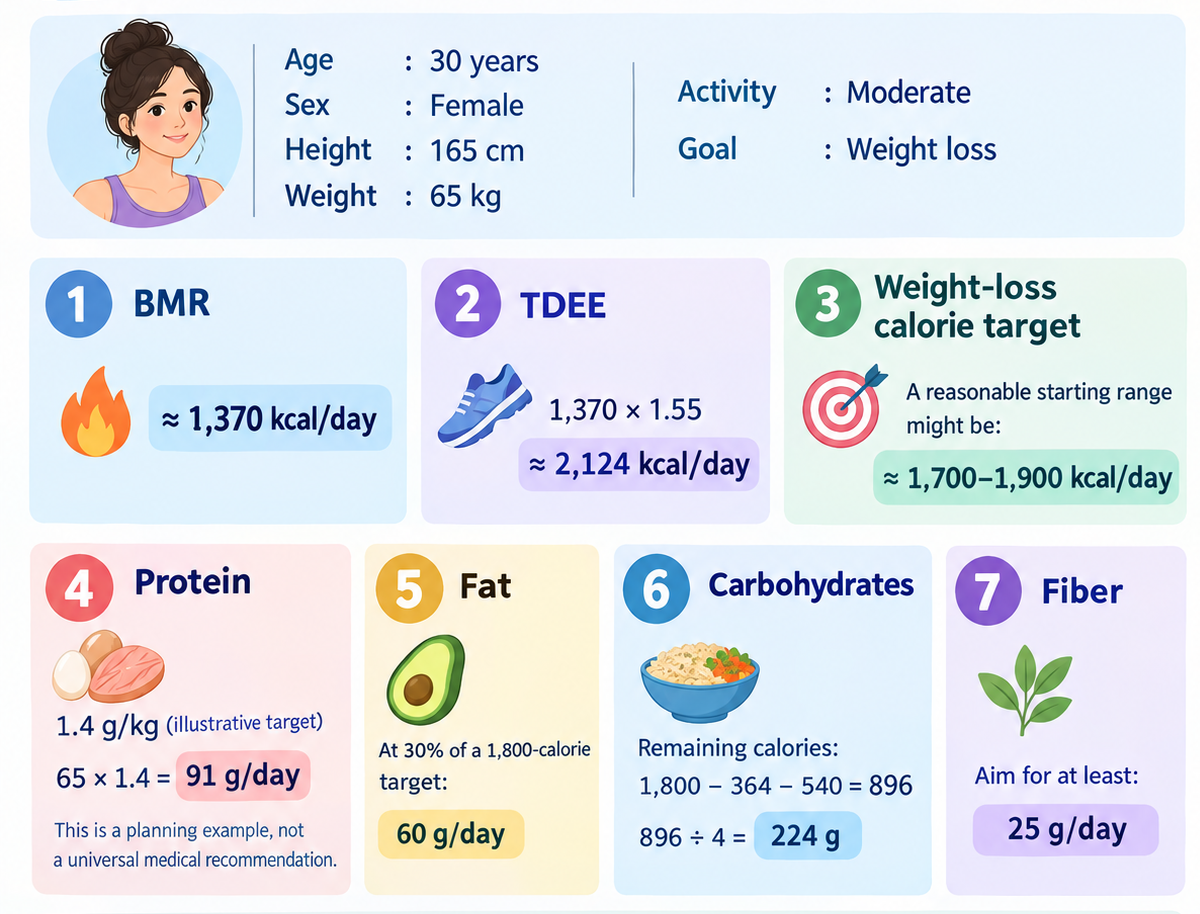
A complete calorie and macro calculator example
Let’s put the process together.
Imagine:
- Age: 30 years
- Sex: Female
- Height: 165 cm
- Weight: 65 kg
- Activity: Moderate
- Goal: Weight loss
Step 1: BMR
≈ 1,370 kcal/day
Step 2: TDEE
1,370 × 1.55 ≈ 2,124 kcal/day
Step 3: Weight-loss calorie target
A reasonable starting range might be:
≈ 1,700–1,900 kcal/day
Step 4: Protein
If using 1.4 g/kg as an illustrative higher-protein planning target:
65 × 1.4 = 91 g/day
This is a planning example, not a universal medical recommendation.
Step 5: Fat
At 30% of a 1,800-calorie target:
60 g/day
Step 6: Carbohydrates
Remaining calories:
1,800 − 364 − 540 = 896 calories
896 ÷ 4 = 224 g carbohydrates
Step 7: Fiber
Aim for at least:
25 g/day
So the example becomes approximately:
| Target | Example |
|---|---|
| Calories | 1,800 kcal |
| Protein | 91 g |
| Fat | 60 g |
| Carbohydrates | 224 g |
| Fiber | ≥25 g |
Also Read : Antioxidants
Also Read : Zinc
Should you use a calorie and macro calculator?
A calculator can make the process easier, especially when you are starting.
However, treat its result as an estimate rather than a measurement.
Your body does not burn exactly the same number of calories every day. Exercise, walking, sleep, food intake, body composition, and other factors can change energy expenditure.
A useful approach is:
- Calculate your BMR.
- Estimate your TDEE.
- Choose your goal.
- Set a reasonable calorie target.
- Set protein.
- Set fat.
- Allocate the remaining calories to carbohydrates.
- Set a practical fiber target.
- Track your trend.
- Adjust gradually when needed.
Also Read : Immunity
What if your calculated calories do not match your results?
Do not immediately assume the calculator is wrong.
Your starting calculation may simply be an imperfect estimate.
For example, if your calculated maintenance is 2,100 calories but your weight trend remains stable around 1,950 calories over several weeks, your real-world maintenance may be closer to that level.
Look at trends rather than single weigh-ins.
Body weight can fluctuate because of water, glycogen, sodium, food volume, menstrual-cycle changes, and other factors.
Also Read : Magnesium
When should you get professional advice?
A calculator is not appropriate for every situation.
Speak with a doctor or registered dietitian before making significant dietary changes if you are:
- Pregnant or breastfeeding
- Under 18
- Living with diabetes or another chronic condition
- Managing kidney, liver, or gastrointestinal disease
- Taking medicines that affect appetite, weight, or metabolism
- Recovering from an illness or surgery
- Experiencing unexplained weight loss or gain
- Dealing with an eating disorder or disordered eating
The NIH Body Weight Planner specifically states that its adult tool is not intended for children or pregnant or breastfeeding women and recommends consulting a healthcare provider for individual health questions.
[NIDDK — About the Body Weight Planner]
Also Read : Minerals
Key Takeaways
- Your daily calorie requirements depend on age, sex, height, weight, activity, and your goal.
- Estimate BMR first, then use activity to estimate TDEE.
- Use TDEE as a starting point for maintenance, then adjust for weight loss or gain.
- Protein can be estimated from body weight, while fat and carbohydrates can be allocated from your calorie target.
- Fiber should come mainly from vegetables, fruits, pulses, whole grains, nuts, and seeds.
- Calculator results are estimates. Your real-world weight and health trends help determine whether your target needs adjustment.
Also Read : Bones
FAQ
How many calories should I eat per day?
How do I calculate my daily protein requirement?
For a general healthy-adult reference, multiply body weight in kilograms by about 0.83 g. Individual needs can differ with age, activity, health, and life stage.
How do I calculate carbohydrates after setting protein and fat?
Multiply protein grams by 4 and fat grams by 9. Subtract those calories from your total calorie target. Divide the remaining calories by 4 to estimate carbohydrate grams.
How much fiber should I eat each day?
Is 1,200 calories enough for weight loss?
Not necessarily. A calorie target should be based on your individual energy needs and health. Very-low-calorie diets can be inappropriate without professional supervision.
Can I use the same calorie target after losing weight?
Not always. Your energy needs can change as body weight, activity, and other factors change. Recalculate or reassess your needs periodically rather than assuming the original number remains accurate.
Also Read : Iodine