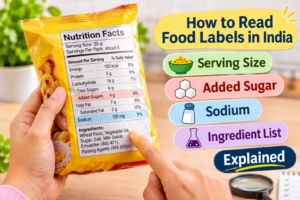
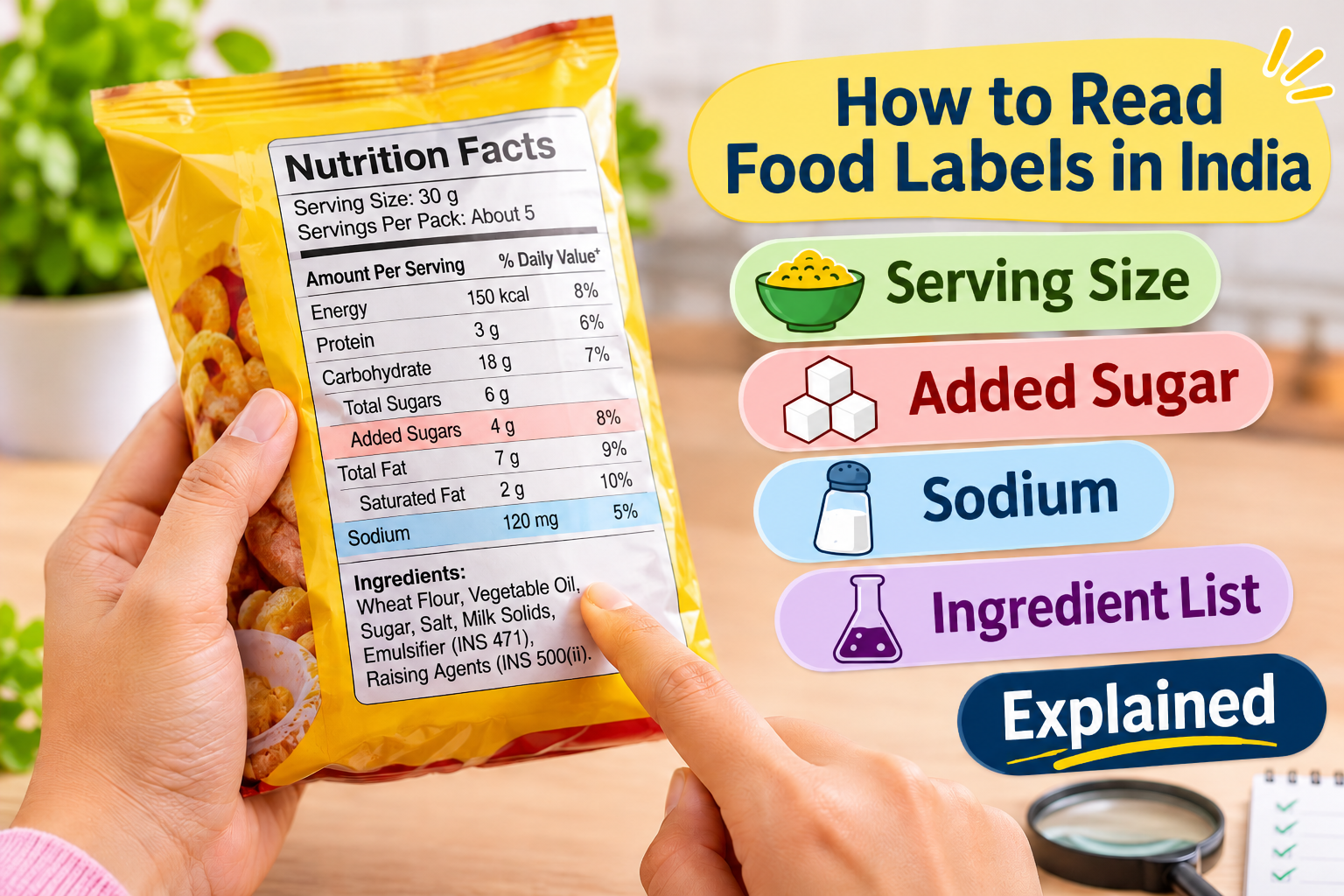
Food labels can help you compare packaged foods, but only when you read the numbers on the correct basis. Begin by checking whether the values apply to 100 g, 100 ml, one serving or the entire pack. Calculate the amount in the portion you expect to eat, and then check added sugar, sodium, saturated fat, ingredients and allergens.
Do not judge a product from words such as natural, multigrain or no added sugar alone. ICMR NIN advises consumers to cross-check claims against the nutrition panel and ingredient list.
To read an Indian food label, first identify whether the nutrition information is given per 100 g, per 100 ml, per serving or for a single-consumption pack. Use per-100-g or per-100-ml values to compare similar products, then calculate the nutrients in the portion you will actually eat. Check added sugar separately from total sugar, compare sodium in milligrams, and read ingredients in descending order by weight. Marketing claims should never replace the information on the back of the package.
Table of Contents
How Can You Read a Food Label in 30 Seconds
- Check the product’s net weight.
- Find the quantity used for the nutrition values.
- Estimate how much you will actually eat.
- Compare added sugar, sodium and saturated fat.
- Read the first several ingredients.
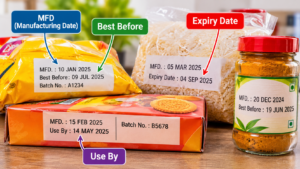
- Check allergens, dates and storage instructions.
- Treat front-of-pack claims as selected claims, not a complete nutritional assessment.
FSSAI requires nutritional information per 100 g, per 100 ml or per single-consumption pack, together with per-serving percentage contributions to specified reference values. Applicable exemptions exist.
FSSAI Labelling and Display Regulations Version VIII: https://www.fssai.gov.in/upload/uploadfiles/files/Comp_Labelling%20Display_Version%20VIII_09_09_2025.pdf
What to check on an Indian food label
Requirements and exemptions vary by product category. Read the complete current package.
| Label element | What it tells you | How to use it |
|---|---|---|
| Name of food | The product's actual identity | Do not rely only on the brand name |
| Net quantity | Total food in the pack | Compare it with serving size |
| Nutrition information | Energy and nutrient amounts | Check the measurement basis first |
| Serving size | A reference portion | Compare it with your real portion |
| Ingredient list | What was used to make the food | Read from the first ingredient onward |
| Allergen declaration | Specified allergenic ingredients | Essential for people with allergies |
| Vegetarian symbol | Ingredient-origin category | It is not a health rating |
| Date and storage | Dating and handling information | Follow the package directions |
| FSSAI details | Regulatory identification | Not proof of ideal nutrition |
Source: FSSAI Labelling and Display Regulations Version VIII
ICMR NIN Dietary Guidelines for Indians 2024 short booklet: https://nin.res.in/downloads/DGI_Booklet_English_CMYK.pdf
Also Read : Migraine
Should You Read Per 100 g or Per Serving
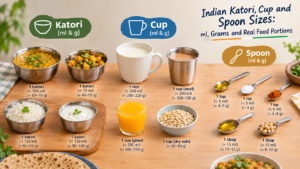
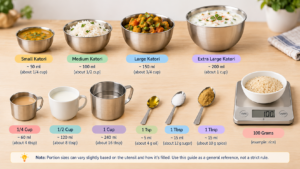
Use per 100 g or per 100 ml to compare similar products. Use per serving to estimate what you will consume, but only if your portion matches the serving on the package.
A serving size is a reference quantity, not necessarily a recommendation. It may be smaller or larger than the amount you normally eat.
Also Read : Calcium Deficiency
Per 100 g Values
- Best for comparing brands of cereal, biscuits or namkeen
- Avoid differences created by unequal serving sizes
- Provide a standard basis for a custom-portion calculation
Also Read : Iron Deficiency
Per Serving Values
- Help estimate one measured portion
- Show per-serving percentage RDA
- Work only when your portion matches the labeled serving
Also Read : How to Cure Piles
How Do You Calculate Nutrients in Your Actual Portion
Calculate what you actually eat
Use the same unit throughout each calculation. A serving printed on the pack is a reference quantity, not necessarily the amount you eat.
Nutrient in your portion = Nutrient per 100 g x Portion weight in grams / 100
Nutrient in your drink = Nutrient per 100 ml x Portion volume in ml / 100
Source: FSSAI Labelling and Display Regulations Version VIII
Also Read : Vitamin D Deficiency
Example calculation for a 30 g portion
Illustrative values only; they do not represent a real product.
| Item | Value per 100 g | Calculation | Amount in 30 g |
|---|---|---|---|
| Energy | 480 kcal | 480 x 30 / 100 | 144 kcal |
| Added sugar | 18 g | 18 x 30 / 100 | 5.4 g |
| Sodium | 620 mg | 620 x 30 / 100 | 186 mg |
These values are original illustrations and do not represent a real brand.
Also Read : Gut Bacteria
What If You Eat the Entire Packet
Number of servings eaten = Amount eaten / Labelled serving size
One serving compared with the whole packet
A 90 g packet with a 30 g serving contains three servings.
| Item | One 30 g serving | Entire 90 g packet |
|---|---|---|
| Energy | 144 kcal | 432 kcal |
| Added sugar | 5.4 g | 16.2 g |
| Sodium | 186 mg | 558 mg |
Eat Right India How to Read Labels: https://eatrightindia.gov.in/EatRightIndia/how-to-read-label.jsp
Also Read : How to Improve Your Five Senses Naturally
Also Read : How to Relieve Toothache
What Is the Difference Between Total Sugar and Added Sugar
Also Read : How to Improve Your Memory & Focus
Total sugar added sugar and claims
A sugar-free claim is permitted only within the applicable FSSAI threshold; no added sugar is a different claim.
| Label term | Meaning | Important limitation |
|---|---|---|
| Total sugar | All sugars measured in the product | Does not show how much was added |
| Added sugar | Sugar added during processing or preparation | Excludes naturally occurring sugar |
| No added sugar | No qualifying sweetening ingredient was added | Naturally occurring sugar can remain |
| Sugar-free | No more than the regulatory sugar threshold | Does not automatically mean calorie-free |
Under FSSAI’s Advertising and Claims Regulations, a sugar-free claim is permitted when a product contains no more than 0.5 g sugar per 100 g or 100 ml. No added sugar has different conditions and does not mean zero total sugar.
FSSAI Advertising and Claims Regulations: https://fssai.gov.in/upload/uploadfiles/files/Compendium_Advertising_Claims_Regulations_14_12_2022.pdf
Also Read : Biohacking
Which Added Sugar Reference Should You Use
FSSAI label calculations use 50 g added sugar per day for an average adult eating 2,000 kcal. This is a regulatory reference for the label. ICMR NIN 2024 describes intake above 5 percent of energy, or about 25 g a day for a 2,000 kcal diet, as high and advises limiting added sugar.
ICMR NIN Dietary Guidelines for Indians 2024: https://www.nin.res.in/dietaryguidelines/pdfjs/locale/DGI07052024P.pdf
Also Read : How to Control Uric Acid
Added sugar calculation
FSSAI uses 50 g added sugar for label percentage RDA calculations, while ICMR-NIN 2024 advises limiting added sugar to about 25 g per day on a 2,000 kcal diet. These figures have different purposes.
Added sugar in 45 g = 12 g per 100 g x 45 / 100 = 5.4 g
Share of a 25 g reference = 5.4 / 25 x 100 = 21.6%
Also Read : Meditation
What Does Sodium Mean on a Food Label
Convert sodium into salt
The salt equivalent is not necessarily the amount of visible table salt added because sodium can come from other ingredients.
Salt in grams = Sodium in milligrams x 2.5 / 1,000
Source: WHO Sodium Reduction
Also Read : Mental Health
Sodium to Salt Example
A packet contains 720 mg sodium.
Example: 720 mg sodium x 2.5 / 1,000 = 1.8 g salt equivalent
This does not mean that 1.8 g of visible table salt was added. Sodium can come from other sodium-containing ingredients.
World Health Organization Sodium Reduction: https://www.who.int/news-room/fact-sheets/detail/sodium-reduction
Also Read : Intermittent Fasting
FSSAI Sodium Claims
Sodium claim conditions
These are legal conditions for claims, not a complete rating of food quality.
| Claim | FSSAI condition |
|---|---|
| Low sodium or salt | No more than 0.12 g sodium per 100 g or 100 ml |
| Very low sodium or salt | No more than 0.04 g sodium per 100 g or 100 ml |
| Sodium or salt-free | No more than 0.005 g sodium per 100 g or 100 ml |
These are legal claim conditions, not a complete judgment of food quality. People with medically prescribed sodium restrictions need individualized advice.
Also Read : Sodium Potassium
How Should You Read the Ingredient List
Except for applicable single-ingredient foods, FSSAI requires ingredients in descending order by weight or volume at manufacture. The first ingredient is present in the largest individual quantity.
If a product lists whole-grain oats, sugar, peanuts, vegetable oil, cocoa and salt, oats are the largest ingredient and sugar exceeds each ingredient after it. Exact percentages cannot be known unless the label supplies them.
Also Read : Mulethi Wonders
The First Three Ingredients Rule Needs Caution
The first three ingredients are useful clues, but they do not necessarily make up most of the product. Order tells you rank, not exact quantities.
Also Read : Triphala
Names That May Indicate Added Sugar
Also Read : Shilajit
Does a Short Ingredient List Always Mean a Healthier Food
Also Read : Morning Rituals
Also Read : Antioxidants
How Can You Compare Two Packaged Foods Fairly
Compare products on the same 100 g basis
Fictional teaching example. Cereal B has less added sugar and more fibre; Cereal A has less sodium.
| Per 100 g | Cereal A | Cereal B |
|---|---|---|
| Energy | 390 kcal | 420 kcal |
| Added sugar | 22 g | 10 g |
| Sodium | 360 mg | 520 mg |
| Fibre | 8 g | 11 g |
| Labelled serving | 30 g | 45 g |
Source: FSSAI Labelling and Display Regulations Version VIII
Cereal B has less added sugar and more fiber, while Cereal A has less sodium. Neither is best on every measure. For the same 40 g portion:
Compare the same amount actually eaten
Fictional teaching example. The more suitable option depends on the reader's overall diet and priority.
| Nutrient in 40 g | Cereal A | Cereal B |
|---|---|---|
| Energy | 156 kcal | 168 kcal |
| Added sugar | 8.8 g | 4 g |
| Sodium | 144 mg | 208 mg |
| Fibre | 3.2 g | 4.4 g |
Source: FSSAI Labelling and Display Regulations Version VIII
The choice depends on the overall diet and priority. Someone limiting sugar may choose differently from someone limiting sodium.
Also Read : Zinc
What Does Percentage RDA Mean
Per-serving percentage RDA estimates how much one labeled serving contributes to FSSAI’s specified daily reference values for an average adult.
Reference values used on Indian labels
These are regulatory reference values for an average adult and are not personalised targets.
| Nutrient | FSSAI label reference |
|---|---|
| Energy | 2,000 kcal |
| Total fat | 67 g |
| Saturated fat | 22 g |
| Trans fat | 2 g |
| Added sugar | 50 g |
| Sodium | 2,000 mg, equivalent to 5 g salt |
Source: FSSAI Labelling and Display Regulations Version VIII
Calculate percentage RDA
Individual needs vary. A percentage on a label does not state the ideal intake for every person.
Per-serving %RDA = Nutrient per serving / Reference amount x 100
Example: 400 mg sodium / 2,000 mg x 100 = 20%
Source: FSSAI Labelling and Display Regulations Version VIII
A serving with 400 mg sodium contributes 20 percent of the 2,000 mg label reference. It does not necessarily supply 20 percent of every person’s ideal intake.
Also Read : Immunity
Can You Trust Claims on the Front of the Pack
What to verify behind common food claims
Cross-check every front-of-pack claim against the nutrition panel and ingredient list.
| Front claim | What to verify on the back |
|---|---|
| Multigrain | Which grains appear first and whether percentages are stated |
| No added sugar | Total sugar and the ingredient list |
| Sugar-free | Calories, fats and other carbohydrates |
| High protein | Protein per 100 g and in your actual portion |
| Low sodium | Whether the nutrition panel meets the claim condition |
| Baked | Total fat and saturated fat |
| Natural | The full ingredient list and nutrition values |
| Fortified | Which nutrients were added and in what amounts |
Also Read : Carbohydrates
What Do the Green and Brown Symbols Mean
The green symbol identifies vegetarian food and the brown symbol identifies non-vegetarian food. They indicate ingredient origin, not calories, sugar, sodium or overall nutritional quality.
Also Read : Anemia
Where Should You Check for Allergens
Look for a Contains declaration and read the ingredient list. FSSAI allergen categories include cereals containing gluten, crustaceans, milk, eggs, fish, peanuts and tree nuts, soybeans, and sulphites at specified concentrations. May contain can warn about possible cross-contamination. People with diagnosed allergies should check every current package.
Also Read : How to Keep Your Mind During Panic News
Eight Common Food Label Mistakes
- Assuming one packet equals one serving. A packet can contain several labeled servings.
- Comparing unequal serving sizes. Compare similar foods per 100 g or 100 ml.
- Reading only calories. Sugar, sodium, fats, fiber and ingredients also matter.
- Treating no added sugar as sugar-free. Naturally occurring sugar can remain.
- Confusing sodium with salt. One gram sodium equals about 2.5 g salt.
- Assuming the green symbol means healthy. It indicates vegetarian status, not nutrition quality.
- Believing every unfamiliar ingredient is harmful. Technical names do not automatically indicate danger.
- Ignoring storage instructions. Directions after opening can affect safety and quality.
Also Read : How to Strengthen Your Nerves
Also Read : Almonds vs Pistachios
A One Minute Grocery Shopping Checklist
- Are the values per 100 g, per serving or per pack?
- How much will I realistically eat?
- How many servings are in the pack?
- What are the added sugar and sodium values?
- Which ingredient appears first?
- Does the front claim match the back label?
- Are relevant allergens declared?
- Are the date and storage directions suitable?
- Am I comparing similar products on the same basis?
- Does this food fit the rest of my diet?
Also Read : Yoga vs Exercise
Frequently Asked Questions
Is per 100 g more useful than per serving?
Per 100 g or 100 ml is normally more useful for comparing similar products. Per-serving information becomes useful after confirming that the serving resembles the amount you eat.
Does no added sugar mean zero sugar?
How do I calculate calories in half a packet?
If the label is for the full packet, divide by two. For per-100-g values, multiply by grams eaten and divide by 100.
Is jaggery counted as added sugar?
When jaggery is added during preparation or manufacturing, ICMR NIN includes it among added sugars.
Is sodium the same as salt?
No. Multiply grams of sodium by 2.5 to estimate grams of salt.
Does the first ingredient make up more than half the product?
Not necessarily. It is the largest individual ingredient but may represent less than half.
Also Read : Magnesium
The Bottom Line
Also Read : Minerals
Medical Disclaimer
This article is for general educational purposes only and is not a substitute for professional medical or dietary advice, diagnosis or treatment. Consult a qualified healthcare professional for guidance appropriate to your medical situation, particularly if you have food allergies or a condition requiring a prescribed diet.
Also Read : Bones
Sources and Further Reading
FSSAI. Labelling and Display Regulations Version VIII September 2025. Verified October 27, 2026. https://www.fssai.gov.in/upload/uploadfiles/files/Comp_Labelling%20Display_Version%20VIII_09_09_2025.pdf
FSSAI. Labelling and Display amendment register. Verified October 27, 2026. https://fssai.gov.in/food-law/regulations/amendments/labelling-display
ICMR NIN. Dietary Guidelines for Indians 2024. Verified October 27, 2026. https://www.nin.res.in/dietaryguidelines/pdfjs/locale/DGI07052024P.pdf
ICMR NIN. Dietary Guidelines short booklet. Verified October 27, 2026. https://nin.res.in/downloads/DGI_Booklet_English_CMYK.pdf
FSSAI Eat Right India. How to Read Labels. Verified October 27, 2026. https://eatrightindia.gov.in/EatRightIndia/how-to-read-label.jsp
FSSAI. Advertising and Claims Regulations. Verified October 27, 2026. https://fssai.gov.in/upload/uploadfiles/files/Compendium_Advertising_Claims_Regulations_14_12_2022.pdf
WHO. Sodium Reduction, updated May 11, 2026. Verified October 27, 2026. https://www.who.int/news-room/fact-sheets/detail/sodium-reduction
Also Read : Iodine
Also Read : Pre Workout