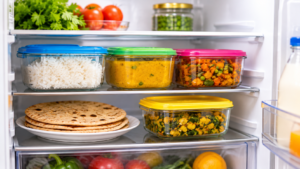
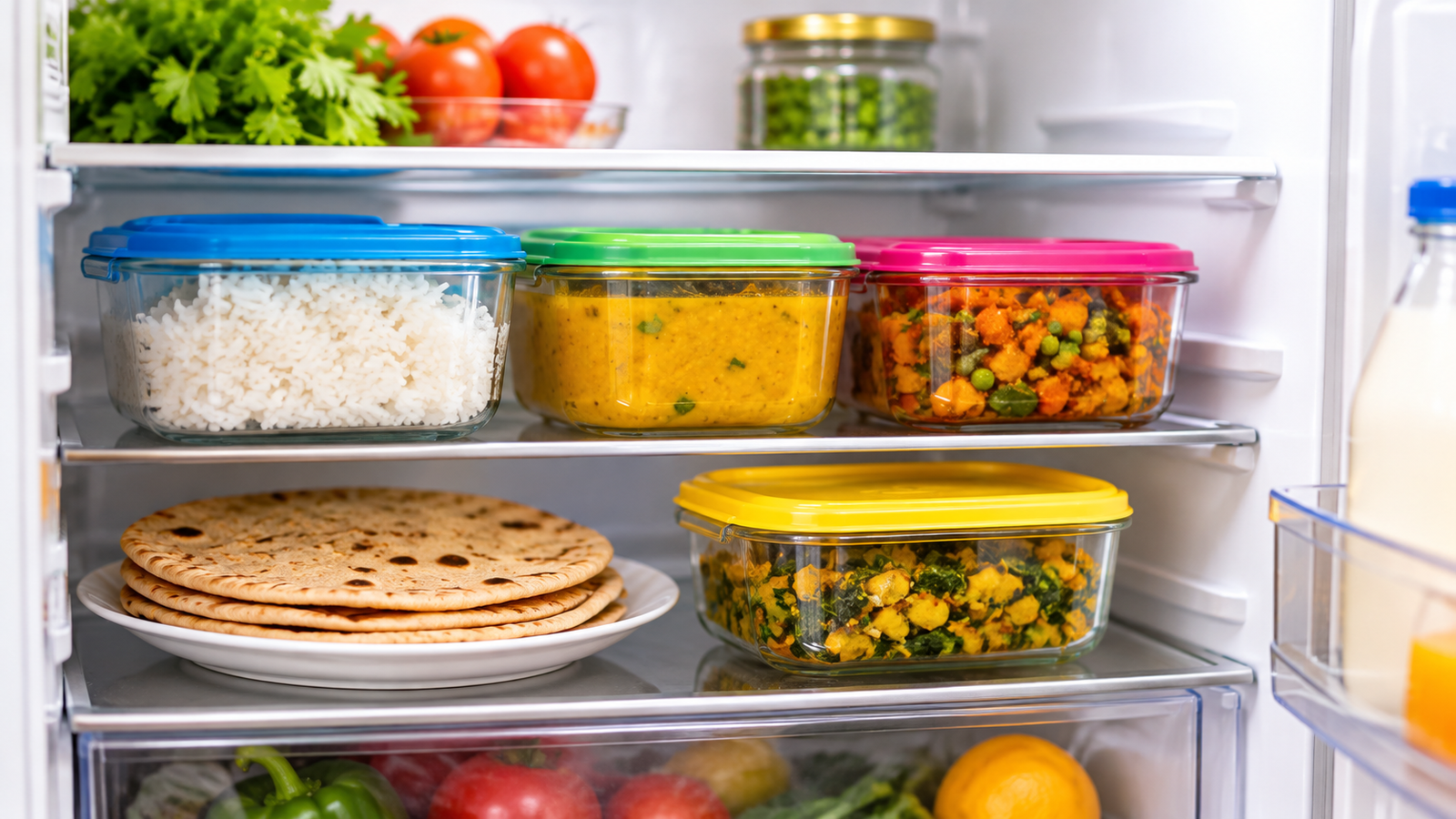
As a conservative rule for Indian homes, refrigerate cooked food within two hours and eat most leftovers, such as dal, sabzi, rajma, chole, and curries, within 48 hours. Refrigerate within one hour when the surrounding temperature is above 32 C. Cooked rice, pulao, biryani, and other rice-based dishes are best cooled quickly and eaten within 24 hours.
Keep the refrigerator at 4 C or below where possible and, in all cases, below 5 C. FSSAI advises storing leftovers below 5 C and not leaving cooked food at room temperature for more than two hours.
FoodSafety.gov permits properly handled cooked leftovers to be refrigerated for up to four days at 4 C or below. However, a 48-hour limit is a more cautious household rule when refrigerator temperature, cooling speed, or power supply is uncertain.
Safe leftovers formula
Safe leftovers = prompt refrigeration + refrigerator at 4 C or below + covered shallow container + use within the recommended time + thorough reheating
Table of Contents
How Long Can Cooked Food Stay in the Fridge in India?
Conservative refrigerator storage times for Indian leftovers
| Cooked food | Conservative refrigerator limit | Practical guidance |
|---|---|---|
| Plain cooked rice | 24 hours | Cool quickly, refrigerate promptly, and reheat only once |
| Pulao, biryani, or fried rice | 24 hours | Follow the rice rule, especially when the dish contains meat or eggs |
| Khichdi | 24 hours | Rice-containing moist food should be treated cautiously |
| Dal or sambar | 48 hours | Divide a large quantity into smaller, shallow containers |
| Rajma, chole, or cooked legumes | 48 hours | Refrigerate promptly; do not leave the cooking pot out overnight |
| Dry sabzi | 48 hours | Store covered and use a clean serving spoon |
| Gravy-based sabzi | 48 hours | Reheat until steaming hot throughout |
| Paneer curry | 48 hours | Keep consistently refrigerated and avoid repeated reheating |
| Chicken or mutton curry | 48 hours | A conservative Indian-home limit; freeze promptly if keeping longer |
| Cooked fish or seafood curry | 24-48 hours | Use the shorter limit if cooling or refrigeration was uncertain |
| Boiled or cooked egg dishes | 48 hours | Refrigerate promptly in a covered container |
| Roti or chapati | 24-48 hours | Mainly a quality-based practical range; freeze for longer storage |
| Stuffed paratha | 24-48 hours | Use 24 hours for moist paneer, potato, or egg fillings |
| Idli, dosa, poha, or upma | 24-48 hours | Moisture and added vegetables may shorten acceptable quality |
| Soup, curry, or gravy | 48 hours | Cool in smaller portions rather than one deep pot |
| Restaurant or takeaway leftovers | 24 hours if uncertain | The time already spent unrefrigerated may be unknown |
These are conservative household recommendations, not official FSSAI shelf-life limits for individual dishes. The UK Food Standards Agency recommends consuming general leftovers within 48 hours and cooked rice within 24 hours.
When food has been cooled correctly and continuously maintained at 4 C or below, FoodSafety.gov lists a three- to four-day refrigerator life for many cooked leftovers.
Also Read : Natural Remedies Backed By Science
What Is the Safest Simple Rule for Indian Homes?
Safest simple rule for Indian homes
Rice: 24 hours. Most other cooked leftovers: 48 hours. Freeze anything that will not be eaten within this period.
A longer three- to four-day limit should be considered only when all of the following conditions are met:
- The food was refrigerated promptly.
- It was stored in a shallow, covered container.
- The refrigerator remained at 4 C or below.
- There was no significant power interruption.
- A clean spoon was used each time.
- The food was not repeatedly warmed and cooled.
The refrigerator timer begins when the food is cooked, not when it is finally placed in the refrigerator.
Also Read : Meditation
Practical Storage Calculation
Dal is cooked at 1:00 p.m. on Monday and refrigerated at 2:00 p.m. Its conservative 48-hour deadline is approximately 1:00 p.m. Wednesday. It does not receive another 48 hours merely because it entered the refrigerator at 2:00 p.m. If it remained on the dining table until 5:00 p.m., it should generally be discarded rather than refrigerated for later. FSSAI advises that cooked food should not remain at room temperature for more than two hours.
Also Read : Toothache
Practical storage calculation
Dal cooked at 1:00 p.m. on Monday + conservative 48-hour limit = use by approximately 1:00 p.m. on Wednesday
The storage clock begins when the food is cooked, not when it is finally placed in the refrigerator. If the dal remained on the dining table until 5:00 p.m., it should generally be discarded rather than refrigerated for later.
Also Read : Morning Rituals
Why Does Cooked Rice Need Extra Care?
Uncooked rice can contain spores of Bacillus cereus. These spores may survive cooking. If cooked rice remains warm or at room temperature for too long, bacteria can multiply and may produce toxins. Reheating may not reliably eliminate toxins that have already formed.
The main risk is therefore not simply old rice. It is rice that cooled too slowly or remained unrefrigerated for too long.
- Cook only the amount required where practical.
- Cool leftover rice as quickly as possible, ideally within one hour.
- Divide a large batch into shallow containers.
- Refrigerate immediately after rapid cooling.
- Eat refrigerated rice within 24 hours.
- Reheat it only once.
- Make sure it is steaming hot throughout before eating.
Also Read : Itching Relief
Can You Refrigerate Hot Rice?
Yes. Do not leave a large pot of rice on the counter for several hours waiting for it to become completely cold. Divide it into smaller, shallow portions so that heat can escape quickly, and refrigerate promptly. FoodSafety.gov and FSSAI consumer guidance recommend shallow containers because they allow leftovers to cool faster.
Can You Reheat Cooked Rice More Than Once?
The safest rule is to reheat rice only once. Reheat only the portion you plan to eat instead of repeatedly warming the entire container. The UK Food Standards Agency specifically advises reheating rice only once.
Also Read : Mindful Tech Use
How Long Can Dal Stay in the Fridge?
Properly cooled and refrigerated dal should preferably be heat within 48 hours in an Indian household. Although properly stored soups and stews may remain safe for three to four days at 4 C or below under FoodSafety.gov guidance, dal can cool slowly when it is left in a deep pressure-cooker vessel. A 48-hour rule provides an additional safety margin when the actual refrigerator temperature is unknown.
- Transfer dal out of the large cooking vessel.
- Divide it between shallow containers.
- Cover and refrigerate promptly.
- Remove only the amount required.
- Bring it to a rapid simmer or boil while stirring before serving.
Adding a fresh tadka does not make improperly stored dal safe. The storage history of the original dal still matters.
Also Read : How to Keep Your Mind Calm
How Long Can Sabzi Stay in the Fridge?
Both dry and gravy-based sabzi should preferably be consumed within 48 hours. Use the shorter end of the range when the sabzi contains paneer, fresh coconut, cream, milk, cooked egg, seafood, a large amount of gravy, or previously reheated ingredients. Dry sabzi may retain its texture longer than gravy-based sabzi, but appearance and texture do not establish microbiological safety. Food contaminated with illness-causing organisms may sometimes look and smell normal.
Also Read : Aloe Vera
How Long Can Roti Stay in the Fridge?
Plain roti or chapati can be kept refrigerated for approximately 24 to 48 hours in a clean, covered container. This is a cautious practical range rather than a specific FSSAI limit.
Roti often becomes dry or tough before it becomes obviously spoiled. Refrigeration also does not correct contamination introduced through unwashed hands, a dirty cloth, or repeated handling.
For longer storage, cool the rotis briefly, separate them with clean food-grade paper if necessary, pack them in a freezer-safe bag, and freeze them in meal-sized portions. Defrost only the number required.
Stuffed parathas containing paneer, egg, potato, or moist vegetables should be treated as perishable cooked food. Use them within 24 to 48 hours or freeze them promptly.
Also Read : How to Strengthen Your Nerve
How Quickly Should Leftovers Go into the Refrigerator?
Refrigerate cooked food within two hours. If the surrounding temperature is above 32 C, refrigerate it within one hour. This shorter limit is especially relevant during Indian summers, outdoor meals, travel, and kitchens without air conditioning.
Do not interpret the two-hour limit as a recommended cooling time. It is an outside limit. Earlier refrigeration is safer.
Also Read : How to Improve Your Five Senses
Room-temperature decision table
| Time left outside | Conditions | Recommended action |
|---|---|---|
| Less than 1 hour | Normal handling | Refrigerate promptly |
| 1-2 hours | Room temperature below 32 C | Refrigerate immediately and use conservatively |
| More than 2 hours | Any normal room temperature | Discard |
| More than 1 hour | Temperature above 32 C | Discard |
| Unknown duration | Takeaway, party, buffet, or travel | Discard if safety cannot be established |
FSSAI identifies approximately 5 C to 60 C as the temperature danger zone in which microorganisms can grow.
Also Read : Yoga vs Exercise
What Refrigerator Temperature Is Safe?
Set the refrigerator to approximately 4 C. FSSAI household guidance says cooked food should be stored below 5 C, while international household food-safety guidance uses 4 C or below as the refrigerator target.
A refrigerator thermometer is more reliable than the cooling-control number printed on the appliance.
- Do not overfill the refrigerator; cold air needs room to circulate.
- Keep cooked food covered.
- Store cooked and ready-to-eat food above raw meat, fish, or poultry.
- Do not store frequently used leftovers in the refrigerator door.
- Label containers with the food name and cooking date.
- Clean spills promptly.
FSSAI recommends keeping cooked food above raw food to reduce cross-contamination.
Also Read : How to Balance Sodium Potassium Levels
How Should You Cool and Store Indian Leftovers?
Step 1 - Portion the Food
Transfer rice, dal, curry, or sabzi from a deep cooking vessel into smaller containers. Smaller portions cool more evenly.
Step 2 - Use Shallow Containers
A large pot of hot dal or biryani can remain warm in the center for a long time. Shallow containers increase the surface area and speed cooling.
Step 3 - Refrigerate Promptly
Step 4 - Cover and Label It
Step 5 - Freeze Food That Will Not Be Used Soon
Also Read : Antioxidants
How Should You Reheat Leftovers Safely?
Reheat only the quantity you intend to eat. Heat it rapidly and evenly until it is steaming hot throughout.
FSSAI licensing guidance states that reheated food should reach a minimum internal temperature of 74 C. When using a microwave, FSSAI advises reaching 74 C and keeping the food covered for five minutes so the temperature can equalize.
The FSSAI Eat Right Handbook uses another consumer instruction: reheat food to at least 70 C for two minutes. Using 74 C as the thermometer target is the more conservative household approach.
Also Read : How to Complete a 30gm Protein Gap
Safe reheating target
Safe reheating target = 74 C in the center of the food + even heating + no cold spots
How Should Dal, Curry, or Gravy Be Reheated?
How Should Food Be Reheated in a Microwave?
Can Reheating Make Food Left Outside Safe Again?
Also Read : Zinc
What Should You Do with Leftovers During a Power Cut?
Also Read : Biohacking
Power-cut decision table
| Power-cut situation | Recommended action |
|---|---|
| Less than 4 hours and door remained closed | Food is generally acceptable if still properly chilled |
| More than 4 hours without temperature evidence | Discard perishable leftovers |
| Food was above 4 C for 2 hours or longer | Discard |
| Ambient temperature exceeded 32 C and food was warm for 1 hour | Discard |
| Food still contains ice crystals in the freezer | It may generally be refrozen |
| Storage history is uncertain | Do not taste-test; discard |
Never taste a questionable leftover to determine whether it is safe.
Also Read : Fiber
When Should You Throw Cooked Food Away?
- It remained at room temperature for more than two hours.
- It remained out for more than one hour above 32 C.
- Its storage time is unknown.
- The container is leaking, swollen, or improperly sealed.
- Mold is visible.
- It has an unusual odor, color, or texture.
- Raw meat juices may have dripped onto it.
- The refrigerator was without power for more than four hours and the food temperature cannot be confirmed.
- It has already been repeatedly reheated and cooled.
- You are unsure whether it was handled safely.
Smelling normal does not prove that food is safe. Some illness-causing microorganisms do not produce an obvious change in smell, appearance, or taste.
Also Read : Magnesium
Who Should Be Extra Careful with Leftovers?
Also Read : Iodine
10 Common Leftover Storage Mistakes
- Leaving rice or dal out overnight.
- Waiting for food to become completely cold before refrigerating it.
- Cooling a large quantity in one deep cooking vessel.
- Storing leftovers in the refrigerator door.
- Repeatedly reheating the entire container.
- Mixing a fresh batch of food with an older batch.
- Using an unwashed serving spoon.
- Assuming boiling will make mishandled food safe.
- Keeping leftovers through a long power cut without checking the temperature.
- Using smell as the only safety test.
Also Read : How Much Protein Do You Need Per Day
Frequently Asked Questions
Can Cooked Food Stay in the Fridge for Seven Days?
Seven days is too long for ordinary refrigerated leftovers. FoodSafety.gov generally limits properly refrigerated cooked leftovers to three or four days, while the conservative rule used in this article is 48 hours for most Indian dishes and 24 hours for rice.
Is Five-Day-Old Dal Safe to Eat?
It should be discarded. Five days exceeds both this article conservative 48-hour rule and the general three- to four-day limit used by FoodSafety.gov for many cooked leftovers.
Can Cooked Rice Be Kept in the Fridge for Two Days?
Can You Store Dal in the Pressure Cooker Overnight?
Only if it is transferred to the refrigerator promptly and the vessel allows the dal to cool sufficiently quickly. A large, deep pressure-cooker vessel may cool slowly, so shallow covered containers are safer.
Should Leftovers Be Stored in Steel, Glass, or Plastic Containers?
Any clean, food-grade, refrigerator-safe container with a secure cover can be used. The container depth and cleanliness matter more than whether it is made from steel, glass, or food-grade plastic.
Can Fresh Dal Be Mixed with Yesterday's Dal?
Do not mix fresh food with older leftovers. The combined batch must be treated according to the age and handling history of the oldest portion.
Does Frying Leftover Rice Make It Safe?
Not if the rice was stored incorrectly or remained at room temperature too long. Frying may heat the rice, but it may not neutralize toxins already produced during unsafe storage.
How Many Times Can Leftovers Be Reheated?
Reheat only the portion required and preferably reheat it once. This is especially important for rice.
Is Food Safe If It Smells Fine?
Not necessarily. Harmful contamination may be present without an obvious change in smell, appearance, or taste.
Also Read : Minerals
When Should You Seek Medical Care?
Common food-poisoning symptoms include diarrhea, stomach cramps, nausea, vomiting, and fever. Seek medical care for bloody diarrhea, diarrhea lasting more than three days, fever above 102 F or 38.9 C, vomiting that prevents you from keeping liquids down, or signs of dehydration.
Pregnant people, young children, older adults, and people with weakened immune systems should seek professional advice earlier if symptoms develop.
Also Read : Carbohydrates
Key Takeaways
- Refrigerate cooked food within two hours, or within one hour above 32 C.
- Keep the refrigerator at 4 C or below where possible and always below 5 C.
- Eat cooked rice, pulao, biryani, and khichdi within 24 hours.
- Use most dal, sabzi, curries, and other leftovers within 48 hours as a conservative Indian-home rule.
- Freeze food promptly if it will not be eaten within the recommended period.
- Reheat only the required portion until it reaches 74 C or is steaming hot throughout.
- Reheating does not rescue food that remained outside too long.
- After a power cut lasting more than four hours, discard perishable leftovers unless safe temperatures can be confirmed.
- When the storage history is uncertain, throw the food away.
Also Read : How to Calculate Macros in Indian Food
Medical and Food-Safety Disclaimer
This article provides general food-safety education and is not a substitute for advice from a qualified healthcare professional or local food-safety authority. Storage safety depends on actual food temperature, hygiene, cooling speed, ingredients, refrigerator performance, and handling history. When safety cannot be established, discard the food.
Also Read : How to Meet Your Daily Protein Target
Sources and Further Reading
- FSSAI – Food Safety at Home
- FSSAI – Eat Right Handbook
- FSSAI – Refrigerator Storage FAQ
- FSSAI – Food Safety Connect
- FSSAI – Temperature Danger Zone FAQ
- UK Food Standards Agency – Cooking and Leftovers
- UK Food Standards Agency – Cooked Rice Safety
- FoodSafety.gov – Cold Food Storage Chart
- FoodSafety.gov – Four Steps to Food Safety
- FSSAI – Licensing Regulations Compendium
- FoodSafety.gov – Food Safety in an Emergency
- FoodSafety.gov – Power-Outage Food Safety Chart
- FoodSafety.gov – People at Risk
- CDC – Food Poisoning Symptoms
Also Read : Calculate Calories